

Inside Swix AI
- FeaturesChat, assistants, automations and agents, built for destination teams.
- Agents (AI Workforce)An agent team that plans the work, does it, and checks in when a person has to decide.
- AI AutomationsQuickFlows, ActionFlows and SmartFlows for the work you repeat.
- AssistantsCustom assistants that know your role, your files and your voice.
- ChatAsk in plain words, get back reports, decks and dashboards.
- AI knowledge baseOne library of your files that everything in Swix reads from.
- Security & TrustHow your data is encrypted, isolated and never used to train outside AI models.
 In their words30 min“What used to take me hours now takes me 30 minutes tops.”Jenna McCormick · Destination Creative & Content Manager, Visit Cheyenne
 AgentsPlans the work, does it, and stops for your okay.
 AI AutomationsA monthly board report, drafted in five numbered steps.
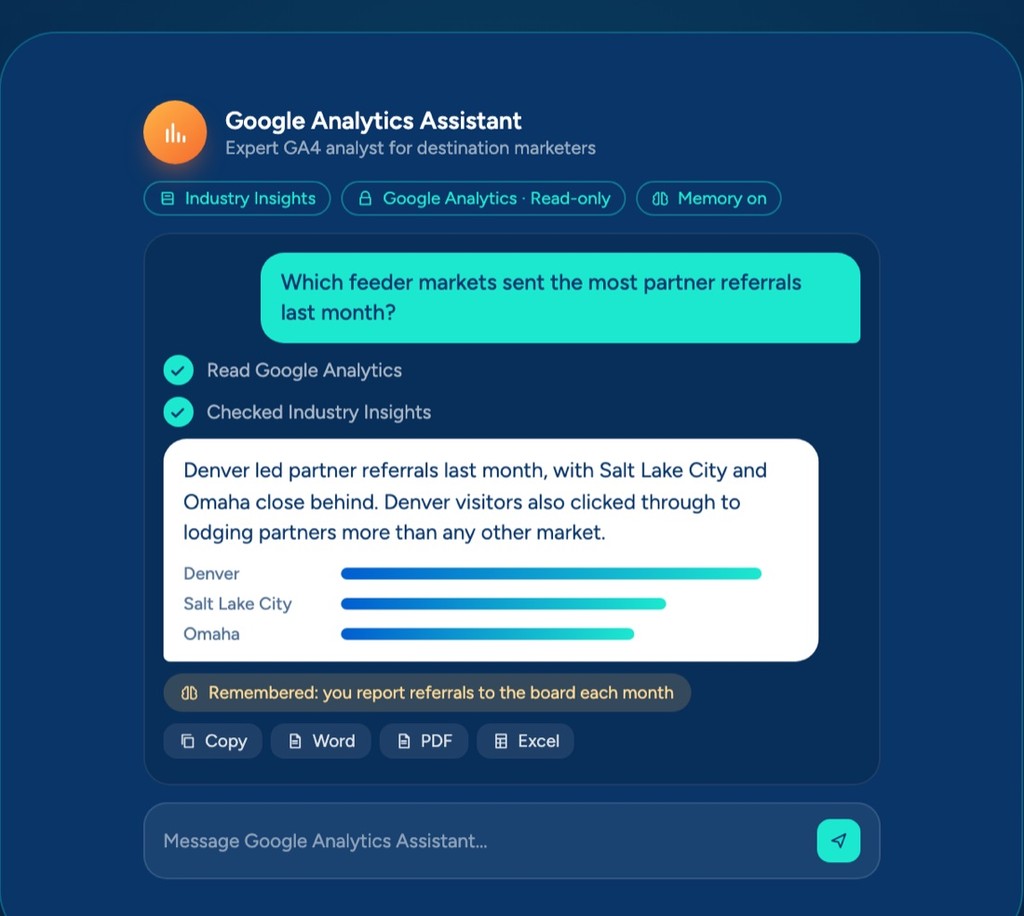 AssistantsAnswers from your Google Analytics, with read-only access.
 ChatOne prompt, a finished board report you can share.
 AI knowledge baseYour files, read by every assistant, agent and flow.
Swix AI
- Reading the inbox
- Drafting RFP replies
- Updating partner listings
- Agents on shift
- Swix
- AI
- Open
Home
BlogJul 27, 2026 · 8 min
Your DMO knows more than it remembers
Your destination knows more than it remembers. Why institutional knowledge keeps leaving your DMO, and how a shared AI second brain fixes it.
Key takeaways
- Most of what makes a DMO good at its job lives in people's heads, and it leaves when they do.
- A knowledge base stores documents, while a second brain connects what's in your files, email, CRM and notes to answer a question.
- Old wikis and shared drives rotted because someone had to maintain them by hand, and AI can now do that upkeep in the background.
- Start by asking the person whose knowledge would hurt most to lose where it lives today.
A few weeks ago the events director at a DMO we work with asked me how to get her ChatGPT history out of OpenAI.
Years of event knowledge were sitting in there, every festival and every lesson learned the hard way, all of it inside her own account. We sent over a short guide on how to export it. Two pages, mostly housekeeping. She pulled the whole thing out and uploaded it into a shared knowledge base her whole team could get at, by herself, before we could offer to help. Then her CEO saw what she'd built and went and did something similar with his.
The part I keep thinking about is that she asked first. Nobody framed it for her. She already understood that years of institutional knowledge living in one person's private chat history, locked in a tool, was a problem waiting to happen. If she'd taken another job, it would have walked out with her, and nobody would have known exactly what they'd lost until the day they needed it.
I've been in and around destination marketing since 2010, over 16 years now, and I've watched plenty of shiny tech roll through and right back out of our world. This one is different, and the longer I sit with it, the more I think it matters for us specifically.
The smartest part of your DMO isn't written down anywhere
Every destination leader knows this, even if we don't say it out loud. Most of what makes your organization good at its job lives in people's heads.
Your convention sales director knows exactly why that 1,500-person medical meeting picked you over the city two states over. Your comms lead knows which stories move travelers and which land with a thud. Your partnerships person knows what a member needs before they do. None of it sits in a system. It's judgment, and taste, built up over years.
Then someone leaves, and a big chunk of that walks out the door with them. You didn't just lose a person, you lost years of context and intelligence nobody had time to write down.
That's the real problem. It isn't a lack of information. It's a lack of memory.
You're already sitting on the answers, you just can't see them
Here's the part that gets me. A lot of what you'd want to know is already yours. It's just buried where no human can read it or in insights that are hard to capture at scale.
Think about your CRM. Years of accounts, planners, deals you won or lost and the notes on why. That's not just data, it's your accumulated judgment sitting in thousands of rows nobody can take in at once. "Which planners are worth our time?" or "why do we keep losing the big citywide medicals?" is probably answerable in there. You've just never had a great way to see the whole picture.
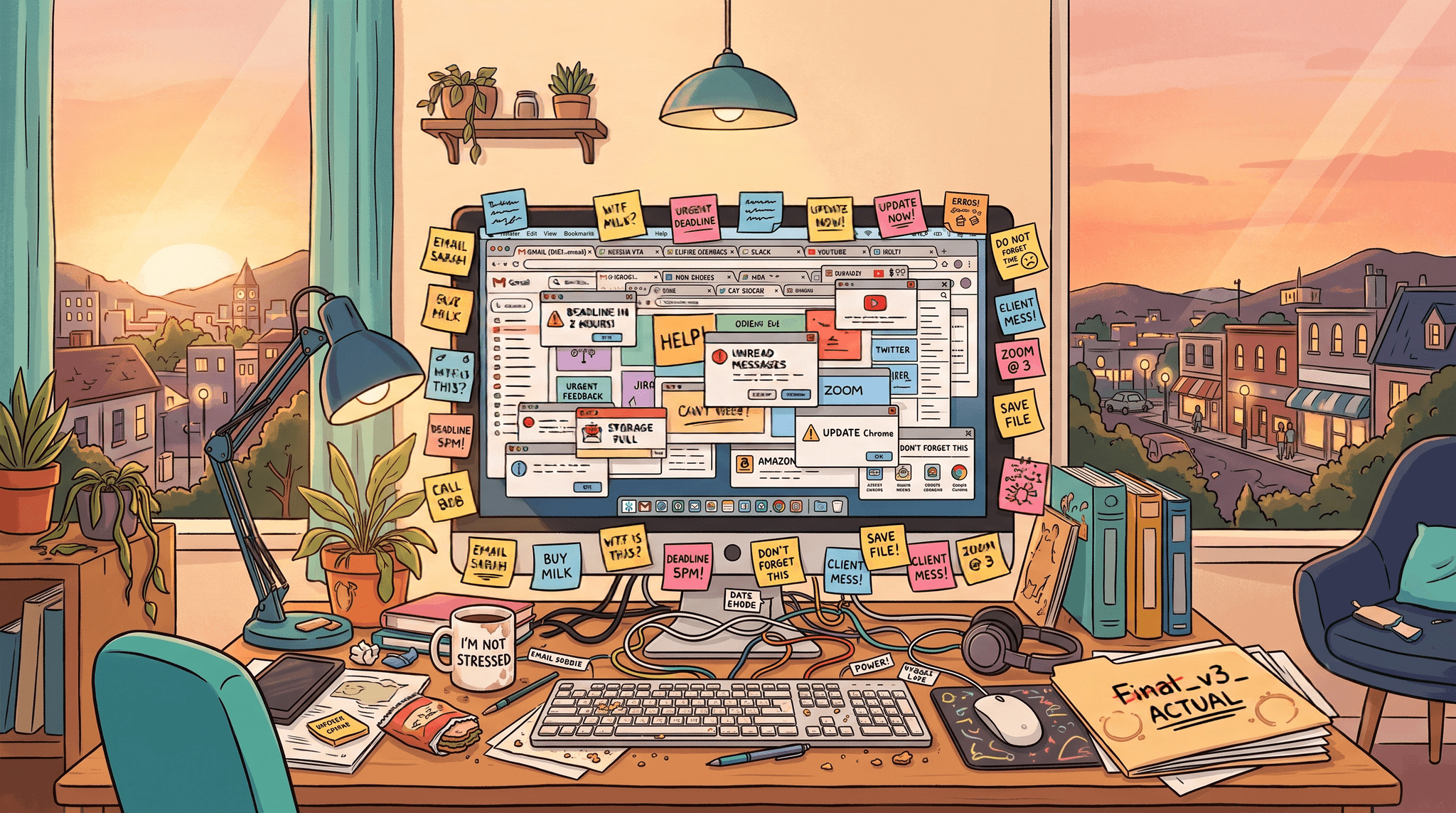
The stuff that is written down is scattered everywhere else. The CRM, Analytics, a shared inbox, Slack, and a graveyard of notes and files named "Final_v3_ACTUAL." So when you ask AI for help, you often get the same generic answer every other destination gets, because it knows little to nothing about yours.
Why every system you've tried eventually rotted
We've all tried to fix this. Wikis, shared drives, Notion, that beautiful color-coded folder system someone built with love in 2019 (guilty). They all died the same death. Somebody had to keep them up by hand, and nobody does for long.
A system you have to feed and tidy every day isn't a system, it's a chore. And chores lose to a busy week, every time. That one's on the tool, not on your team.
What's different now is that the upkeep stops being your job. The AI can do the reading, sorting, and connecting in the background, and the capturing happens where you already work. You forward an email, clip an article, drop a note after a call, and it lands in the right place on its own. Take away the maintenance and you take away the reason these systems always rotted. Better still, it starts to compound, resurfacing something from a spring campaign right when you're planning the fall one.
A filing cabinet isn't a brain
One distinction trips people up all the time. A knowledge base and a second brain aren't the same thing, and you want both.
A knowledge base is a filing cabinet. It stores your documents so you can find them, and most of you have some version of it. But a cabinet only gives back exactly what you put in, one folder at a time.
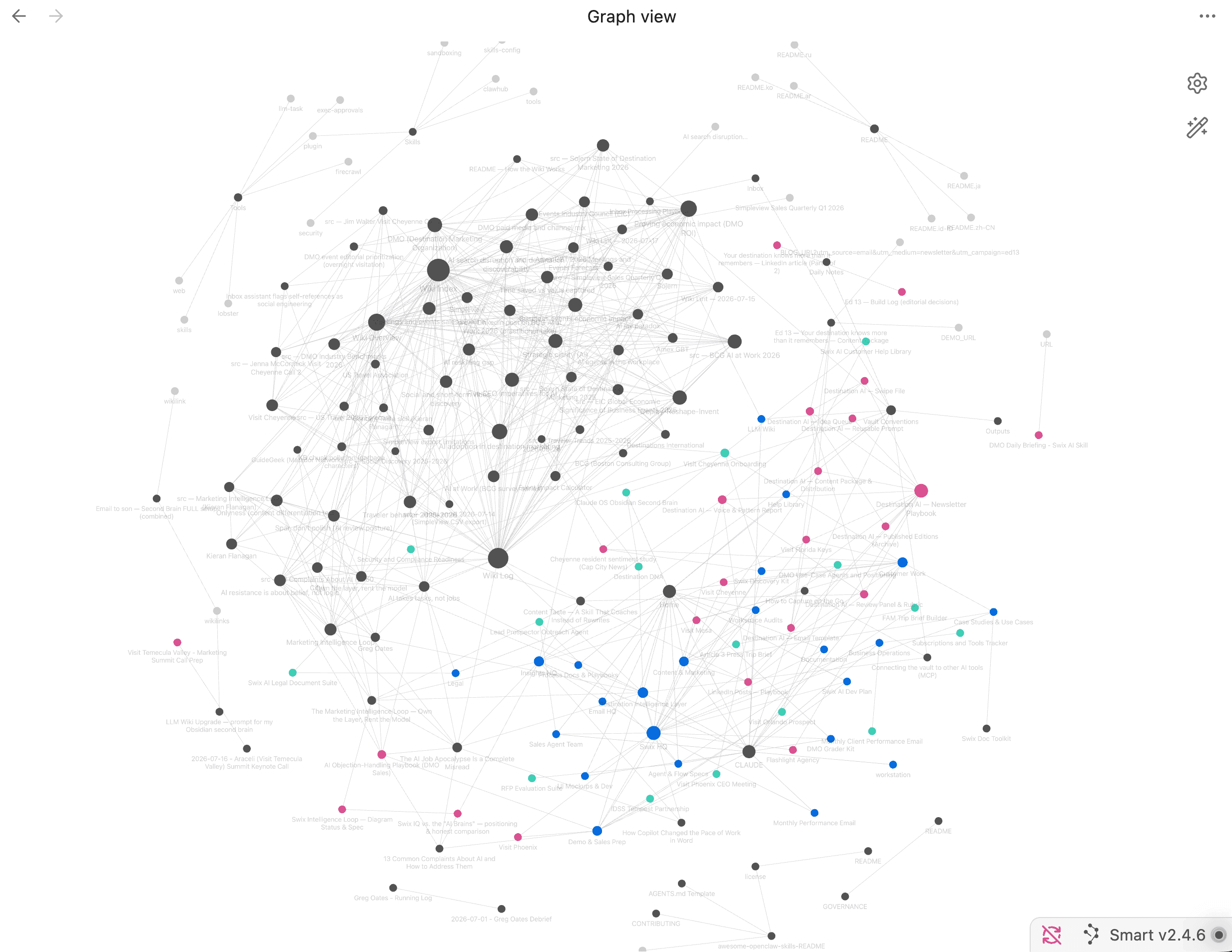
A second brain is the colleague who's read every file in that cabinet, plus the emails, the CRM, and the notes from every call, and remembers what mattered. You don't ask it to fetch a document. You ask it a question, and it connects things across all of it to answer. One stores. The other thinks. The cabinet keeps you organized, but the brain is where the insight lives, and it's the part almost nobody has yet.
Make it the destination's memory, not one person's
The trap is letting this stay personal. If it lives in one director's head or a private notebook, you're back where you started the day they leave.
That's no knock on the personal versions. Plenty of sharp people in our industry are building their own right now and getting real value out of them (myself included), and if that's where you start, start there. But a personal brain solves one person's problem. The organization still forgets.
What holds up is one shared memory the whole destination feeds from every direction. Your CRM, sales notes, marketing results, the docs and decks, the takeaways from a partner call, a trade show and the dozens of other places knowledge hides. Each department pours in what it learns, the best of it rises to where everyone can see it, and the brain gets sharper the more it's fed. The whole point is one person's insight becoming something the entire team or organization can stand on.
Why this matters more for us than for the tech giants
Honestly, I think DMOs might need this more than the tech companies building it first.
We run lean, so a memory that never forgets is a real gift to a one-person department. Turnover can be high in a lot of our roles, so "the knowledge walks out the door" isn't a worst case, it's a normal Q3. And we sit where proving what worked is hard, so a clean record of your wins, and the why behind them, is worth its weight in budget defense.
There's one more piece, maybe the one I care about most. The best destination marketing isn't informational, it's emotional. Pure Michigan. "What Happens in Vegas." The taste behind work like that never makes it into a document, and it's the first thing you lose when a great creative lead moves on. That's the stuff most worth keeping.
What this actually looks like
Let me make it concrete. A new sales manager starts Monday. Normally that's six months of ramp. With a destination memory, she asks, "Why did we win the state education convention and lose the regional medical one?" and gets the real answer, with the notes behind it, in the time it takes to pour a coffee. She's useful by week two, not month six.
That's what it changes at the everyday level: faster onboarding, fewer dropped balls, and a real record when someone asks what the money actually bought. Your destination stops losing its memory every time a person leaves, and grows more valuable as knowledge accumulates.
But that's just recall. What excites me is when it connects the dots on its own.
My friend Greg Oates, who writes the 2050 City newsletter, got at this recently better than I could. He asked us to picture a DMO with its own AI operating system wired into every department's knowledge base in real time, where a CEO could simply ask, "Where do you see opportunity to increase European visitation in Q3?" His read was that it's just a matter of time before that's a reality. I think he's right, and I didn't want to wait for someone else to build it, which is why we started months ago on a version made for destinations. More on that soon...
So imagine asking "what do the planners we actually win have in common?" and getting a pattern back from five years of data and other information. Most came from one region, booked your shoulder season, and cared more about walkability than price. That's not a report, it's a targeting strategy you can act on immediately.
That's the leap. You go from a memory that remembers to one that helps you see what you couldn't. I'll be honest, that's the promise, not a magic button you press today. But it's the right thing to build toward, and it's closer than it sounds.
Own the part that's actually yours
I should say plainly that I didn't come up with any of this. Some of the sharpest people in tech have been building what they call "AI second brains" for a while now, and Kieran Flanagan has written about it as well as anyone. His work is what got me thinking about what it would mean for destinations. One line I'll borrow straight from him, because I haven't found a better way to say it:rent the model, own the intelligence layer.
The AI models are becoming a commodity, and they'll keep changing every few months. So don't bet on a model. Own the thing that's truly yours, your destination's accumulated intelligence, and plug whatever the best model is that week into it. Your edge lives in what your people know, and you can't rent that from anybody.
The way I've come to think about it, there are three parts and you need all three. There's your people's judgment, which is the part no software is ever going to replace. There's the AI itself, which is the engine, and which is quickly becoming a commodity. And in between them there's the intelligence layer, your destination's accumulated context, which is the piece almost nobody has yet. Most destinations right now are shopping for the engine. The advantage is in the middle.
The gap is already widening
It's tempting to file this under "stuff only tech people can do." I don't buy it. The people building these range from serious engineers to a former CEO who just wanted his AI to sit in on his meetings. The entry point is lower than it looks.
The part I keep coming back to is this. Destinations that start building their memory and intelligence layer now create something that gets a little more valuable every day, while everyone else keeps starting from scratch. That gap doesn't hold steady, it widens.
If you want a starting point that costs you nothing, try this. Pick the one person on your team whose knowledge would hurt the most to lose, and ask them where it currently lives. Most of the time the honest answer is some version of "my head, my inbox, a notebook and my own chat history." That answer is the whole problem, said out loud, and it's the beginning of the work.
But the tool matters less than the mindset, and Greg made that point too. He pushed back on selling AI to our teams as "efficiency" and argued the real point is clarity, freeing up our headspace to be creative and present instead of buried in what he calls our digital dumpster fire. He's right, and it's the same reason a destination memory and intelligence layer matters. Clear the noise and your team gets back to the work only they can do.
So here's my question: is your destination's knowledge something you actually own and compound, or is it quietly walking out the door with your best people?
-Jason
Real credit to Kieran Flanagan, whose writing on AI "brains" got me down this road (kieranflanagan.substack.com), and to Greg Oates, whose June 20 piece for 2050 City is where the "clarity, not efficiency" reframe and the DMO operating system idea both come from. Go read the whole thing, it's better than my summary of it.
Questions people ask
How do DMOs keep institutional knowledge when staff leave?
Move it out of personal inboxes, notebooks and private chat histories into one shared memory the whole team feeds. That way one person's insight becomes something everyone can use.
What is the difference between a knowledge base and an AI second brain?
A knowledge base is a filing cabinet that gives back the documents you put in. A second brain has read everything across your files, emails, CRM and call notes, and connects it to answer a question.
What does "rent the model, own the intelligence layer" mean?
AI models keep changing and are becoming a commodity, so it doesn't pay to bet on one. Own your destination's accumulated knowledge and plug in whichever model is best at the time.
How can a shared AI memory help a new DMO hire?
A new sales manager can ask why the destination won one convention and lost another, and get the answer with the notes behind it. That can make someone useful in weeks instead of months.
BlogJul 27, 2026 · 8 min
Your DMO knows more than it remembers
Your destination knows more than it remembers. Why institutional knowledge keeps leaving your DMO, and how a shared AI second brain fixes it.
Key takeaways
- Most of what makes a DMO good at its job lives in people's heads, and it leaves when they do.
- A knowledge base stores documents, while a second brain connects what's in your files, email, CRM and notes to answer a question.
- Old wikis and shared drives rotted because someone had to maintain them by hand, and AI can now do that upkeep in the background.
- Start by asking the person whose knowledge would hurt most to lose where it lives today.
A few weeks ago the events director at a DMO we work with asked me how to get her ChatGPT history out of OpenAI.
Years of event knowledge were sitting in there, every festival and every lesson learned the hard way, all of it inside her own account. We sent over a short guide on how to export it. Two pages, mostly housekeeping. She pulled the whole thing out and uploaded it into a shared knowledge base her whole team could get at, by herself, before we could offer to help. Then her CEO saw what she'd built and went and did something similar with his.
The part I keep thinking about is that she asked first. Nobody framed it for her. She already understood that years of institutional knowledge living in one person's private chat history, locked in a tool, was a problem waiting to happen. If she'd taken another job, it would have walked out with her, and nobody would have known exactly what they'd lost until the day they needed it.
I've been in and around destination marketing since 2010, over 16 years now, and I've watched plenty of shiny tech roll through and right back out of our world. This one is different, and the longer I sit with it, the more I think it matters for us specifically.
The smartest part of your DMO isn't written down anywhere
Every destination leader knows this, even if we don't say it out loud. Most of what makes your organization good at its job lives in people's heads.
Your convention sales director knows exactly why that 1,500-person medical meeting picked you over the city two states over. Your comms lead knows which stories move travelers and which land with a thud. Your partnerships person knows what a member needs before they do. None of it sits in a system. It's judgment, and taste, built up over years.
Then someone leaves, and a big chunk of that walks out the door with them. You didn't just lose a person, you lost years of context and intelligence nobody had time to write down.
That's the real problem. It isn't a lack of information. It's a lack of memory.
You're already sitting on the answers, you just can't see them
Here's the part that gets me. A lot of what you'd want to know is already yours. It's just buried where no human can read it or in insights that are hard to capture at scale.
Think about your CRM. Years of accounts, planners, deals you won or lost and the notes on why. That's not just data, it's your accumulated judgment sitting in thousands of rows nobody can take in at once. "Which planners are worth our time?" or "why do we keep losing the big citywide medicals?" is probably answerable in there. You've just never had a great way to see the whole picture.
The stuff that is written down is scattered everywhere else. The CRM, Analytics, a shared inbox, Slack, and a graveyard of notes and files named "Final_v3_ACTUAL." So when you ask AI for help, you often get the same generic answer every other destination gets, because it knows little to nothing about yours.
Why every system you've tried eventually rotted
We've all tried to fix this. Wikis, shared drives, Notion, that beautiful color-coded folder system someone built with love in 2019 (guilty). They all died the same death. Somebody had to keep them up by hand, and nobody does for long.
A system you have to feed and tidy every day isn't a system, it's a chore. And chores lose to a busy week, every time. That one's on the tool, not on your team.
What's different now is that the upkeep stops being your job. The AI can do the reading, sorting, and connecting in the background, and the capturing happens where you already work. You forward an email, clip an article, drop a note after a call, and it lands in the right place on its own. Take away the maintenance and you take away the reason these systems always rotted. Better still, it starts to compound, resurfacing something from a spring campaign right when you're planning the fall one.
A filing cabinet isn't a brain
One distinction trips people up all the time. A knowledge base and a second brain aren't the same thing, and you want both.
A knowledge base is a filing cabinet. It stores your documents so you can find them, and most of you have some version of it. But a cabinet only gives back exactly what you put in, one folder at a time.
A second brain is the colleague who's read every file in that cabinet, plus the emails, the CRM, and the notes from every call, and remembers what mattered. You don't ask it to fetch a document. You ask it a question, and it connects things across all of it to answer. One stores. The other thinks. The cabinet keeps you organized, but the brain is where the insight lives, and it's the part almost nobody has yet.
Make it the destination's memory, not one person's
The trap is letting this stay personal. If it lives in one director's head or a private notebook, you're back where you started the day they leave.
That's no knock on the personal versions. Plenty of sharp people in our industry are building their own right now and getting real value out of them (myself included), and if that's where you start, start there. But a personal brain solves one person's problem. The organization still forgets.
What holds up is one shared memory the whole destination feeds from every direction. Your CRM, sales notes, marketing results, the docs and decks, the takeaways from a partner call, a trade show and the dozens of other places knowledge hides. Each department pours in what it learns, the best of it rises to where everyone can see it, and the brain gets sharper the more it's fed. The whole point is one person's insight becoming something the entire team or organization can stand on.
Why this matters more for us than for the tech giants
Honestly, I think DMOs might need this more than the tech companies building it first.
We run lean, so a memory that never forgets is a real gift to a one-person department. Turnover can be high in a lot of our roles, so "the knowledge walks out the door" isn't a worst case, it's a normal Q3. And we sit where proving what worked is hard, so a clean record of your wins, and the why behind them, is worth its weight in budget defense.
There's one more piece, maybe the one I care about most. The best destination marketing isn't informational, it's emotional. Pure Michigan. "What Happens in Vegas." The taste behind work like that never makes it into a document, and it's the first thing you lose when a great creative lead moves on. That's the stuff most worth keeping.
What this actually looks like
Let me make it concrete. A new sales manager starts Monday. Normally that's six months of ramp. With a destination memory, she asks, "Why did we win the state education convention and lose the regional medical one?" and gets the real answer, with the notes behind it, in the time it takes to pour a coffee. She's useful by week two, not month six.
That's what it changes at the everyday level: faster onboarding, fewer dropped balls, and a real record when someone asks what the money actually bought. Your destination stops losing its memory every time a person leaves, and grows more valuable as knowledge accumulates.
But that's just recall. What excites me is when it connects the dots on its own.
My friend Greg Oates, who writes the 2050 City newsletter, got at this recently better than I could. He asked us to picture a DMO with its own AI operating system wired into every department's knowledge base in real time, where a CEO could simply ask, "Where do you see opportunity to increase European visitation in Q3?" His read was that it's just a matter of time before that's a reality. I think he's right, and I didn't want to wait for someone else to build it, which is why we started months ago on a version made for destinations. More on that soon...
So imagine asking "what do the planners we actually win have in common?" and getting a pattern back from five years of data and other information. Most came from one region, booked your shoulder season, and cared more about walkability than price. That's not a report, it's a targeting strategy you can act on immediately.
That's the leap. You go from a memory that remembers to one that helps you see what you couldn't. I'll be honest, that's the promise, not a magic button you press today. But it's the right thing to build toward, and it's closer than it sounds.
Own the part that's actually yours
I should say plainly that I didn't come up with any of this. Some of the sharpest people in tech have been building what they call "AI second brains" for a while now, and Kieran Flanagan has written about it as well as anyone. His work is what got me thinking about what it would mean for destinations. One line I'll borrow straight from him, because I haven't found a better way to say it:rent the model, own the intelligence layer.
The AI models are becoming a commodity, and they'll keep changing every few months. So don't bet on a model. Own the thing that's truly yours, your destination's accumulated intelligence, and plug whatever the best model is that week into it. Your edge lives in what your people know, and you can't rent that from anybody.
The way I've come to think about it, there are three parts and you need all three. There's your people's judgment, which is the part no software is ever going to replace. There's the AI itself, which is the engine, and which is quickly becoming a commodity. And in between them there's the intelligence layer, your destination's accumulated context, which is the piece almost nobody has yet. Most destinations right now are shopping for the engine. The advantage is in the middle.
The gap is already widening
It's tempting to file this under "stuff only tech people can do." I don't buy it. The people building these range from serious engineers to a former CEO who just wanted his AI to sit in on his meetings. The entry point is lower than it looks.
The part I keep coming back to is this. Destinations that start building their memory and intelligence layer now create something that gets a little more valuable every day, while everyone else keeps starting from scratch. That gap doesn't hold steady, it widens.
If you want a starting point that costs you nothing, try this. Pick the one person on your team whose knowledge would hurt the most to lose, and ask them where it currently lives. Most of the time the honest answer is some version of "my head, my inbox, a notebook and my own chat history." That answer is the whole problem, said out loud, and it's the beginning of the work.
But the tool matters less than the mindset, and Greg made that point too. He pushed back on selling AI to our teams as "efficiency" and argued the real point is clarity, freeing up our headspace to be creative and present instead of buried in what he calls our digital dumpster fire. He's right, and it's the same reason a destination memory and intelligence layer matters. Clear the noise and your team gets back to the work only they can do.
So here's my question: is your destination's knowledge something you actually own and compound, or is it quietly walking out the door with your best people?
-Jason
Real credit to Kieran Flanagan, whose writing on AI "brains" got me down this road (kieranflanagan.substack.com), and to Greg Oates, whose June 20 piece for 2050 City is where the "clarity, not efficiency" reframe and the DMO operating system idea both come from. Go read the whole thing, it's better than my summary of it.
Questions people ask
How do DMOs keep institutional knowledge when staff leave?
Move it out of personal inboxes, notebooks and private chat histories into one shared memory the whole team feeds. That way one person's insight becomes something everyone can use.
What is the difference between a knowledge base and an AI second brain?
A knowledge base is a filing cabinet that gives back the documents you put in. A second brain has read everything across your files, emails, CRM and call notes, and connects it to answer a question.
What does "rent the model, own the intelligence layer" mean?
AI models keep changing and are becoming a commodity, so it doesn't pay to bet on one. Own your destination's accumulated knowledge and plug in whichever model is best at the time.
How can a shared AI memory help a new DMO hire?
A new sales manager can ask why the destination won one convention and lost another, and get the answer with the notes behind it. That can make someone useful in weeks instead of months.
BlogJul 27, 2026 · 8 min
Your destination knows more than it remembers. Why institutional knowledge keeps leaving your DMO, and how a shared AI second brain fixes it.
Key takeaways
- Most of what makes a DMO good at its job lives in people's heads, and it leaves when they do.
- A knowledge base stores documents, while a second brain connects what's in your files, email, CRM and notes to answer a question.
- Old wikis and shared drives rotted because someone had to maintain them by hand, and AI can now do that upkeep in the background.
- Start by asking the person whose knowledge would hurt most to lose where it lives today.
A few weeks ago the events director at a DMO we work with asked me how to get her ChatGPT history out of OpenAI.
Years of event knowledge were sitting in there, every festival and every lesson learned the hard way, all of it inside her own account. We sent over a short guide on how to export it. Two pages, mostly housekeeping. She pulled the whole thing out and uploaded it into a shared knowledge base her whole team could get at, by herself, before we could offer to help. Then her CEO saw what she'd built and went and did something similar with his.
The part I keep thinking about is that she asked first. Nobody framed it for her. She already understood that years of institutional knowledge living in one person's private chat history, locked in a tool, was a problem waiting to happen. If she'd taken another job, it would have walked out with her, and nobody would have known exactly what they'd lost until the day they needed it.
I've been in and around destination marketing since 2010, over 16 years now, and I've watched plenty of shiny tech roll through and right back out of our world. This one is different, and the longer I sit with it, the more I think it matters for us specifically.
The smartest part of your DMO isn't written down anywhere
Every destination leader knows this, even if we don't say it out loud. Most of what makes your organization good at its job lives in people's heads.
Your convention sales director knows exactly why that 1,500-person medical meeting picked you over the city two states over. Your comms lead knows which stories move travelers and which land with a thud. Your partnerships person knows what a member needs before they do. None of it sits in a system. It's judgment, and taste, built up over years.
Then someone leaves, and a big chunk of that walks out the door with them. You didn't just lose a person, you lost years of context and intelligence nobody had time to write down.
That's the real problem. It isn't a lack of information. It's a lack of memory.
You're already sitting on the answers, you just can't see them
Here's the part that gets me. A lot of what you'd want to know is already yours. It's just buried where no human can read it or in insights that are hard to capture at scale.
Think about your CRM. Years of accounts, planners, deals you won or lost and the notes on why. That's not just data, it's your accumulated judgment sitting in thousands of rows nobody can take in at once. "Which planners are worth our time?" or "why do we keep losing the big citywide medicals?" is probably answerable in there. You've just never had a great way to see the whole picture.
The stuff that is written down is scattered everywhere else. The CRM, Analytics, a shared inbox, Slack, and a graveyard of notes and files named "Final_v3_ACTUAL." So when you ask AI for help, you often get the same generic answer every other destination gets, because it knows little to nothing about yours.
Why every system you've tried eventually rotted
We've all tried to fix this. Wikis, shared drives, Notion, that beautiful color-coded folder system someone built with love in 2019 (guilty). They all died the same death. Somebody had to keep them up by hand, and nobody does for long.
A system you have to feed and tidy every day isn't a system, it's a chore. And chores lose to a busy week, every time. That one's on the tool, not on your team.
What's different now is that the upkeep stops being your job. The AI can do the reading, sorting, and connecting in the background, and the capturing happens where you already work. You forward an email, clip an article, drop a note after a call, and it lands in the right place on its own. Take away the maintenance and you take away the reason these systems always rotted. Better still, it starts to compound, resurfacing something from a spring campaign right when you're planning the fall one.
A filing cabinet isn't a brain
One distinction trips people up all the time. A knowledge base and a second brain aren't the same thing, and you want both.
A knowledge base is a filing cabinet. It stores your documents so you can find them, and most of you have some version of it. But a cabinet only gives back exactly what you put in, one folder at a time.
A second brain is the colleague who's read every file in that cabinet, plus the emails, the CRM, and the notes from every call, and remembers what mattered. You don't ask it to fetch a document. You ask it a question, and it connects things across all of it to answer. One stores. The other thinks. The cabinet keeps you organized, but the brain is where the insight lives, and it's the part almost nobody has yet.
Make it the destination's memory, not one person's
The trap is letting this stay personal. If it lives in one director's head or a private notebook, you're back where you started the day they leave.
That's no knock on the personal versions. Plenty of sharp people in our industry are building their own right now and getting real value out of them (myself included), and if that's where you start, start there. But a personal brain solves one person's problem. The organization still forgets.
What holds up is one shared memory the whole destination feeds from every direction. Your CRM, sales notes, marketing results, the docs and decks, the takeaways from a partner call, a trade show and the dozens of other places knowledge hides. Each department pours in what it learns, the best of it rises to where everyone can see it, and the brain gets sharper the more it's fed. The whole point is one person's insight becoming something the entire team or organization can stand on.
Why this matters more for us than for the tech giants
Honestly, I think DMOs might need this more than the tech companies building it first.
We run lean, so a memory that never forgets is a real gift to a one-person department. Turnover can be high in a lot of our roles, so "the knowledge walks out the door" isn't a worst case, it's a normal Q3. And we sit where proving what worked is hard, so a clean record of your wins, and the why behind them, is worth its weight in budget defense.
There's one more piece, maybe the one I care about most. The best destination marketing isn't informational, it's emotional. Pure Michigan. "What Happens in Vegas." The taste behind work like that never makes it into a document, and it's the first thing you lose when a great creative lead moves on. That's the stuff most worth keeping.
What this actually looks like
Let me make it concrete. A new sales manager starts Monday. Normally that's six months of ramp. With a destination memory, she asks, "Why did we win the state education convention and lose the regional medical one?" and gets the real answer, with the notes behind it, in the time it takes to pour a coffee. She's useful by week two, not month six.
That's what it changes at the everyday level: faster onboarding, fewer dropped balls, and a real record when someone asks what the money actually bought. Your destination stops losing its memory every time a person leaves, and grows more valuable as knowledge accumulates.
But that's just recall. What excites me is when it connects the dots on its own.
My friend Greg Oates, who writes the 2050 City newsletter, got at this recently better than I could. He asked us to picture a DMO with its own AI operating system wired into every department's knowledge base in real time, where a CEO could simply ask, "Where do you see opportunity to increase European visitation in Q3?" His read was that it's just a matter of time before that's a reality. I think he's right, and I didn't want to wait for someone else to build it, which is why we started months ago on a version made for destinations. More on that soon...
So imagine asking "what do the planners we actually win have in common?" and getting a pattern back from five years of data and other information. Most came from one region, booked your shoulder season, and cared more about walkability than price. That's not a report, it's a targeting strategy you can act on immediately.
That's the leap. You go from a memory that remembers to one that helps you see what you couldn't. I'll be honest, that's the promise, not a magic button you press today. But it's the right thing to build toward, and it's closer than it sounds.
Own the part that's actually yours
I should say plainly that I didn't come up with any of this. Some of the sharpest people in tech have been building what they call "AI second brains" for a while now, and Kieran Flanagan has written about it as well as anyone. His work is what got me thinking about what it would mean for destinations. One line I'll borrow straight from him, because I haven't found a better way to say it:rent the model, own the intelligence layer.
The AI models are becoming a commodity, and they'll keep changing every few months. So don't bet on a model. Own the thing that's truly yours, your destination's accumulated intelligence, and plug whatever the best model is that week into it. Your edge lives in what your people know, and you can't rent that from anybody.
The way I've come to think about it, there are three parts and you need all three. There's your people's judgment, which is the part no software is ever going to replace. There's the AI itself, which is the engine, and which is quickly becoming a commodity. And in between them there's the intelligence layer, your destination's accumulated context, which is the piece almost nobody has yet. Most destinations right now are shopping for the engine. The advantage is in the middle.
The gap is already widening
It's tempting to file this under "stuff only tech people can do." I don't buy it. The people building these range from serious engineers to a former CEO who just wanted his AI to sit in on his meetings. The entry point is lower than it looks.
The part I keep coming back to is this. Destinations that start building their memory and intelligence layer now create something that gets a little more valuable every day, while everyone else keeps starting from scratch. That gap doesn't hold steady, it widens.
If you want a starting point that costs you nothing, try this. Pick the one person on your team whose knowledge would hurt the most to lose, and ask them where it currently lives. Most of the time the honest answer is some version of "my head, my inbox, a notebook and my own chat history." That answer is the whole problem, said out loud, and it's the beginning of the work.
But the tool matters less than the mindset, and Greg made that point too. He pushed back on selling AI to our teams as "efficiency" and argued the real point is clarity, freeing up our headspace to be creative and present instead of buried in what he calls our digital dumpster fire. He's right, and it's the same reason a destination memory and intelligence layer matters. Clear the noise and your team gets back to the work only they can do.
So here's my question: is your destination's knowledge something you actually own and compound, or is it quietly walking out the door with your best people?
-Jason
Real credit to Kieran Flanagan, whose writing on AI "brains" got me down this road (kieranflanagan.substack.com), and to Greg Oates, whose June 20 piece for 2050 City is where the "clarity, not efficiency" reframe and the DMO operating system idea both come from. Go read the whole thing, it's better than my summary of it.
Questions people ask
How do DMOs keep institutional knowledge when staff leave?
Move it out of personal inboxes, notebooks and private chat histories into one shared memory the whole team feeds. That way one person's insight becomes something everyone can use.
What is the difference between a knowledge base and an AI second brain?
A knowledge base is a filing cabinet that gives back the documents you put in. A second brain has read everything across your files, emails, CRM and call notes, and connects it to answer a question.
What does "rent the model, own the intelligence layer" mean?
AI models keep changing and are becoming a commodity, so it doesn't pay to bet on one. Own your destination's accumulated knowledge and plug in whichever model is best at the time.
How can a shared AI memory help a new DMO hire?
A new sales manager can ask why the destination won one convention and lost another, and get the answer with the notes behind it. That can make someone useful in weeks instead of months.
Book a demo
Ready when you are.
Tell us where the hours go. We'll show you Swix working on your destination's real work, and what your first 60 days would look like.
No slides. No obligation.
Book a demo
Ready when you are.
Tell us where the hours go. We'll show you Swix working on your destination's real work, and what your first 60 days would look like.
No slides. No obligation.