

Inside Swix AI
- FeaturesChat, assistants, automations and agents, built for destination teams.
- Agents (AI Workforce)An agent team that plans the work, does it, and checks in when a person has to decide.
- AI AutomationsQuickFlows, ActionFlows and SmartFlows for the work you repeat.
- AssistantsCustom assistants that know your role, your files and your voice.
- ChatAsk in plain words, get back reports, decks and dashboards.
- AI knowledge baseOne library of your files that everything in Swix reads from.
- Security & TrustHow your data is encrypted, isolated and never used to train outside AI models.
 In their words30 min“What used to take me hours now takes me 30 minutes tops.”Jenna McCormick · Destination Creative & Content Manager, Visit Cheyenne
 AgentsPlans the work, does it, and stops for your okay.
 AI AutomationsA monthly board report, drafted in five numbered steps.
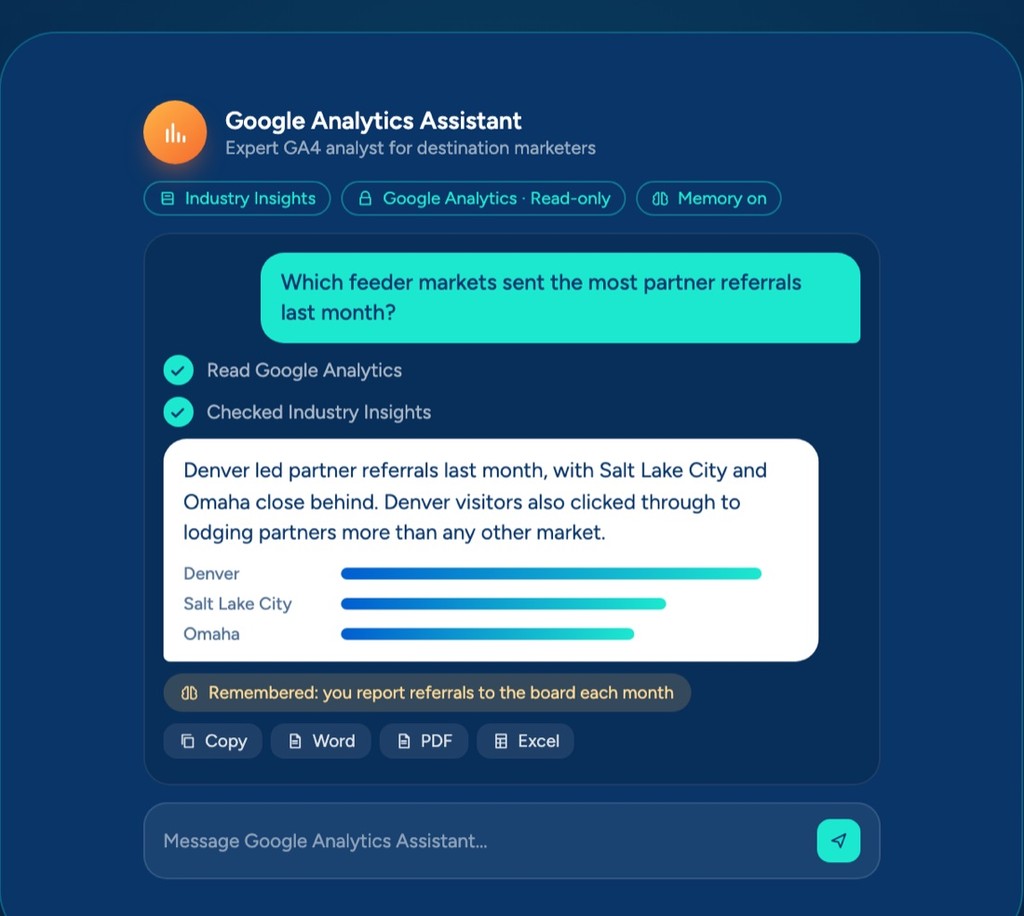 AssistantsAnswers from your Google Analytics, with read-only access.
 ChatOne prompt, a finished board report you can share.
 AI knowledge baseYour files, read by every assistant, agent and flow.
Swix AI
- Reading the inbox
- Drafting RFP replies
- Updating partner listings
- Agents on shift
- Swix
- AI
- Open
Home
BlogJul 8, 2026 · 5 min
Your Team's Saving Hours With AI. Where Are They Going?
BCG found AI users save a workday a week, but most of it vanishes into busywork. Here's how DMO teams can turn saved time into real strategic value.

Key takeaways
- BCG's 2026 AI at Work study found 42% of frontline employees who use AI regularly save at least a full workday a week, and 60% in marketing.
- Two-thirds got little or no guidance on using that time, so it quietly refilled with more of the same work.
- Decide where saved hours go before you automate, point them at work only a person can do, and put that time on the calendar.
- Redirecting reclaimed time is a leadership job, and it sticks best when the whole workflow gets rethought, not just one step.
The stat that stopped me
BCG just released their fourth annual "AI at Work" study, almost 12,000 people worldwide. One number jumped out. Forty-two percent of frontline employees who use AI regularly now save at least a full workday every week. In marketing specifically, it's even higher, at 60%. That's not a rounding error. That's a whole day, and then some, for the people who do our kind of work.
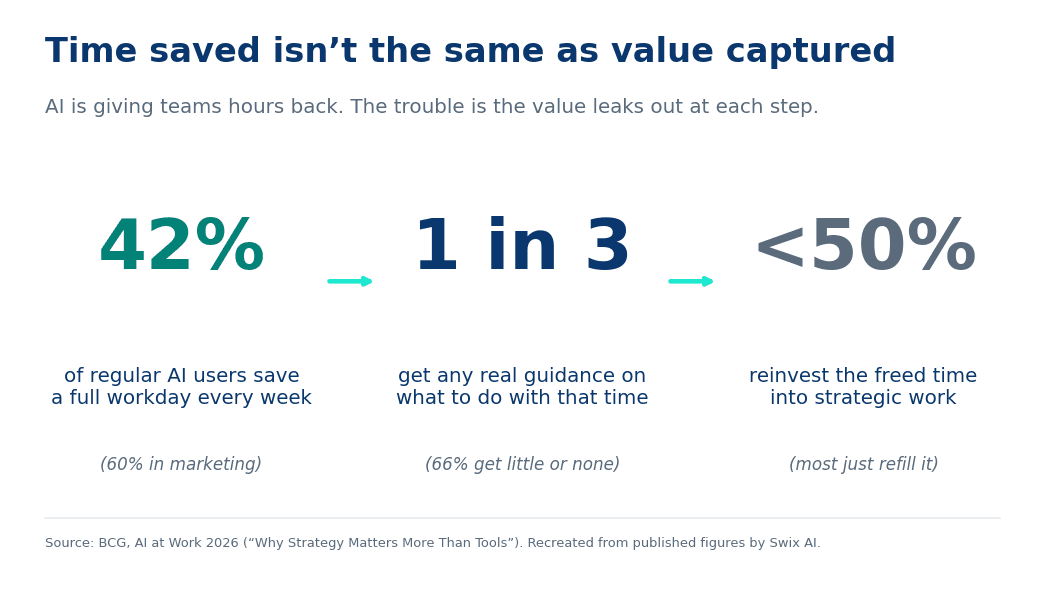
But the finding underneath it is the one that actually matters. Two-thirds of those same people got little or no guidance on what to do with the time they saved.
More than half didn't redirect it toward anything strategic. It just quietly refilled with more of the same.
BCG calls this the gap between "time saved" and "value captured." I'd say it plainer. Saving time isn't the win. It's the setup for the win. And most teams are stopping at the setup.
It's not really a tool problem
Here's the reframe I keep coming back to. The hours AI saves are just raw material. What matters is what your team turns them into. BCG's headline this year says it plainly: strategy matters more than tools. Employees with a clear plan but limited tools actually outperform those with great tools and no direction.
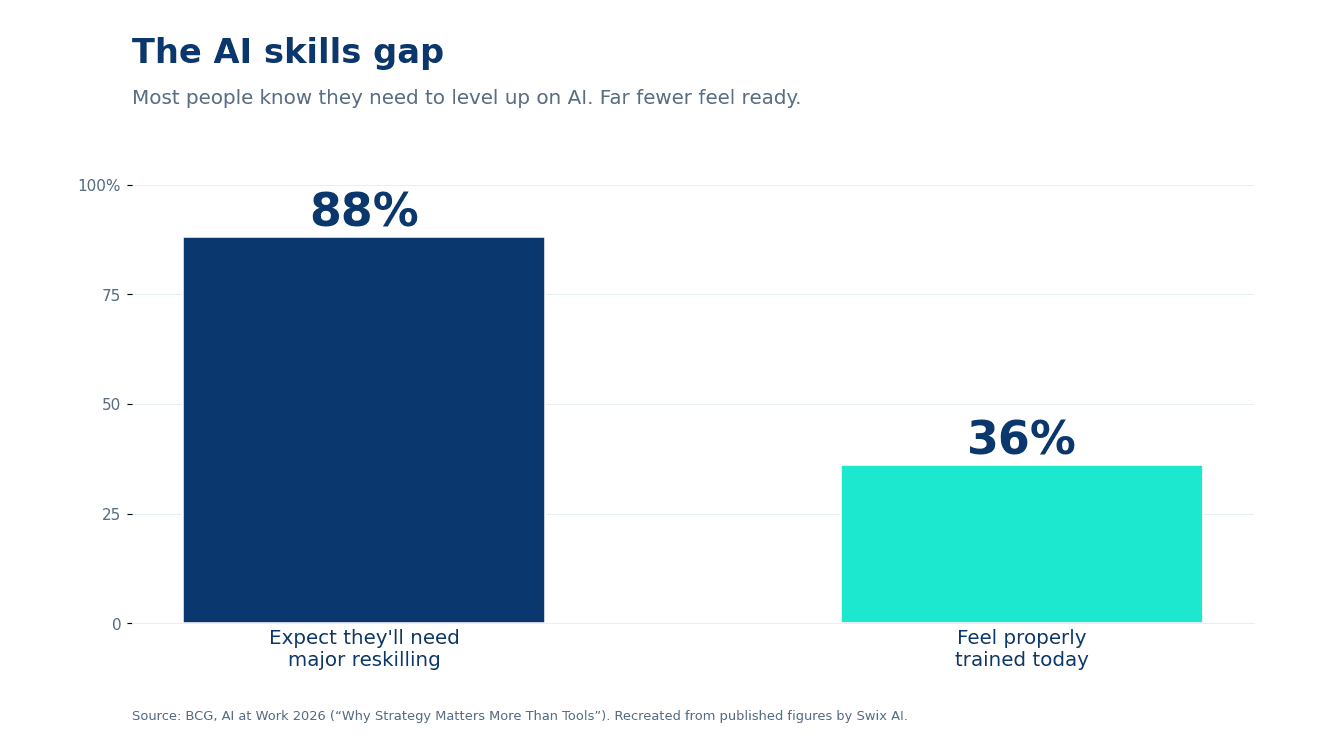
There's a skills piece underneath this too, and it surprised me. In the same study, 88% of people expect they'll need serious re-skilling in the next few years, but only 36% feel properly trained today. That gap has less to do with knowing which buttons to press and more to do with how people actually work. Using AI well is more like building a new set of habits than learning a piece of software once.
Direction plus habits is what turns a saved hour into a better outcome.
If your budget is tight, that's genuinely good news. The expensive part was never the software. It's the strategy, and helping your team build the new habits to go with it. Full disclosure, that's a big part of what we focus on at Swix, less about the tool, more about the way of working around it. It matters here because it's usually the missing piece between "we saved time" and "we did something better with it."
Why this hits DMOs harder
You've been told to do more with less for years, and it hasn't let up. Budgets are flat. Teams are small. So when AI hands one of your people an afternoon back, the gravity of the job pulls it straight into the next pile. Another report. More inbox. A meeting that could've been an email.
Think about your social media coordinator. She used to spend most of Thursday writing next week's posts one at a time. Now an agent drafts the whole week in twenty minutes and she cleans it up. The win looks obvious. But if that reclaimed afternoon just fills with more small tasks, the tool worked perfectly and nothing actually changed. You automated your way back onto the same treadmill.
That's why "we got AI" and "AI is helping us" are not the same sentence. The tool is the easy part.
Here's what got me thinking about this. We're onboarding a DMO team right now, and part of our setup is asking each person one simple question: if we automate the busywork, what would you actually do with the time? The answers stuck with me. The events coordinator said she'd spend it building real relationships with local businesses and partners, and claw back a little work-life balance. The new marketing director said she'd finally get to the big-picture strategy she never has room for. A content creator juggling a young family just wanted to protect her personal time and get back to the creative work she loves.
Not one of them said "more tasks." They all knew exactly where the time should go. So the gap BCG found isn't that people don't know what they'd do with reclaimed time. It's that once the time shows up, nothing helps them actually protect it.
What the best teams actually do
The teams capturing real value do one unglamorous thing differently. They decide, on purpose and ahead of time, where the saved hours go. Three habits can help make it stick:
- Name the time before you save it. Decide what the freed hour is for before you automate the task. "When the weekly social drafts get handled, that time goes to pitching two local stories to press." If you don't name it, the job names it for you, and the job always says "more tasks."
- Point it at the work only a human can do. The real storytelling. The stubborn stakeholder relationship. Actually visiting the new business that wants to be featured. That's where a reclaimed afternoon earns its keep.
- Protect it like a meeting. Put it on the calendar. Unprotected time doesn't survive a busy week, and you know that better than anyone.
Whose job is this, really?
Here's the part that took me a while to see. Redeploying that reclaimed time is really a leadership job, not something to pin on the coordinator. If nobody at the top decides the freed hours go to strategy, they default to whatever shouts loudest, and that's almost always more email.
I saw a sharp take on this recently (hat tip below) describing a project inside one of the largest companies in the world. They were getting steady productivity gains from AI, which sounds great, but not the breakthrough gains leadership expected. The reason was painfully human. People got time back and just refilled it with more small tasks. Productivity, it turns out, can quietly become the enemy of innovation. Someone has to own the redeployment, or it doesn't happen.
For a DMO, that someone is usually you: the director, the CEO, whoever sets the week's priorities. It's a small shift. Instead of celebrating that a tool saved the team five hours, ask where those five hours actually went, and then protect the answer.
Part of why it slips away
There's a structural reason too. BCG found the organizations seeing real gains aren't the ones that bolted AI onto a single task. They're the ones that redesigned the whole workflow, and that kind of rethink-the-process work has nearly doubled since last year.
For a lean DMO team, the lesson is to not just automate the annoying step. Step back and ask what the whole process is even for. If you automate one paragraph of a board report but the report still takes three rounds of email to pull together, you saved a paragraph and kept the mess. Rethink the process, and the time you free up is actually yours to keep.
You don't need a big rollout to start. Pick one task your team automated, or is about to. Decide where that hour goes before it disappears. Then guard it.
The time is already there for a lot of you. The only question left is whether you spend it, or it spends you.
-Jason
Credit where it's due: the data here is from BCG's "AI at Work 2026" report, "Why Strategy Matters More Than Tools": https://www.bcg.com/publications/2026/ai-at-work-why-strategy-matters-more-than-tools. And a hat tip to Conor Grennan, whose LinkedIn post on the study sparked the leadership angle: https://www.linkedin.com/posts/conorgrennan_i-freakin-love-studies-that-match-with-reality-share-7479904231047667712-saIp
Questions people ask
How much time does AI actually save employees?
BCG's 2026 AI at Work study found 42% of frontline employees who use AI regularly save at least a full workday every week. In marketing it was 60%.
Why don't AI time savings show up in results?
Most people got little or no guidance on what to do with the time, so it filled back up with small tasks. BCG calls this the gap between time saved and value captured.
How can a DMO team make AI time savings stick?
Name what the freed hour is for before you automate the task, aim it at work only a person can do, and protect it on the calendar like a meeting.
Who should decide how time saved by AI gets used?
Leadership. If nobody at the top decides the hours go to strategy, they default to whatever is loudest, which is usually more email.
BlogJul 8, 2026 · 5 min
BCG found AI users save a workday a week, but most of it vanishes into busywork. Here's how DMO teams can turn saved time into real strategic value.
Key takeaways
- BCG's 2026 AI at Work study found 42% of frontline employees who use AI regularly save at least a full workday a week, and 60% in marketing.
- Two-thirds got little or no guidance on using that time, so it quietly refilled with more of the same work.
- Decide where saved hours go before you automate, point them at work only a person can do, and put that time on the calendar.
- Redirecting reclaimed time is a leadership job, and it sticks best when the whole workflow gets rethought, not just one step.
The stat that stopped me
BCG just released their fourth annual "AI at Work" study, almost 12,000 people worldwide. One number jumped out. Forty-two percent of frontline employees who use AI regularly now save at least a full workday every week. In marketing specifically, it's even higher, at 60%. That's not a rounding error. That's a whole day, and then some, for the people who do our kind of work.
But the finding underneath it is the one that actually matters. Two-thirds of those same people got little or no guidance on what to do with the time they saved.
More than half didn't redirect it toward anything strategic. It just quietly refilled with more of the same.
BCG calls this the gap between "time saved" and "value captured." I'd say it plainer. Saving time isn't the win. It's the setup for the win. And most teams are stopping at the setup.
It's not really a tool problem
Here's the reframe I keep coming back to. The hours AI saves are just raw material. What matters is what your team turns them into. BCG's headline this year says it plainly: strategy matters more than tools. Employees with a clear plan but limited tools actually outperform those with great tools and no direction.
There's a skills piece underneath this too, and it surprised me. In the same study, 88% of people expect they'll need serious re-skilling in the next few years, but only 36% feel properly trained today. That gap has less to do with knowing which buttons to press and more to do with how people actually work. Using AI well is more like building a new set of habits than learning a piece of software once.
Direction plus habits is what turns a saved hour into a better outcome.
If your budget is tight, that's genuinely good news. The expensive part was never the software. It's the strategy, and helping your team build the new habits to go with it. Full disclosure, that's a big part of what we focus on at Swix, less about the tool, more about the way of working around it. It matters here because it's usually the missing piece between "we saved time" and "we did something better with it."
Why this hits DMOs harder
You've been told to do more with less for years, and it hasn't let up. Budgets are flat. Teams are small. So when AI hands one of your people an afternoon back, the gravity of the job pulls it straight into the next pile. Another report. More inbox. A meeting that could've been an email.
Think about your social media coordinator. She used to spend most of Thursday writing next week's posts one at a time. Now an agent drafts the whole week in twenty minutes and she cleans it up. The win looks obvious. But if that reclaimed afternoon just fills with more small tasks, the tool worked perfectly and nothing actually changed. You automated your way back onto the same treadmill.
That's why "we got AI" and "AI is helping us" are not the same sentence. The tool is the easy part.
Here's what got me thinking about this. We're onboarding a DMO team right now, and part of our setup is asking each person one simple question: if we automate the busywork, what would you actually do with the time? The answers stuck with me. The events coordinator said she'd spend it building real relationships with local businesses and partners, and claw back a little work-life balance. The new marketing director said she'd finally get to the big-picture strategy she never has room for. A content creator juggling a young family just wanted to protect her personal time and get back to the creative work she loves.
Not one of them said "more tasks." They all knew exactly where the time should go. So the gap BCG found isn't that people don't know what they'd do with reclaimed time. It's that once the time shows up, nothing helps them actually protect it.
What the best teams actually do
The teams capturing real value do one unglamorous thing differently. They decide, on purpose and ahead of time, where the saved hours go. Three habits can help make it stick:
- Name the time before you save it. Decide what the freed hour is for before you automate the task. "When the weekly social drafts get handled, that time goes to pitching two local stories to press." If you don't name it, the job names it for you, and the job always says "more tasks."
- Point it at the work only a human can do. The real storytelling. The stubborn stakeholder relationship. Actually visiting the new business that wants to be featured. That's where a reclaimed afternoon earns its keep.
- Protect it like a meeting. Put it on the calendar. Unprotected time doesn't survive a busy week, and you know that better than anyone.
Whose job is this, really?
Here's the part that took me a while to see. Redeploying that reclaimed time is really a leadership job, not something to pin on the coordinator. If nobody at the top decides the freed hours go to strategy, they default to whatever shouts loudest, and that's almost always more email.
I saw a sharp take on this recently (hat tip below) describing a project inside one of the largest companies in the world. They were getting steady productivity gains from AI, which sounds great, but not the breakthrough gains leadership expected. The reason was painfully human. People got time back and just refilled it with more small tasks. Productivity, it turns out, can quietly become the enemy of innovation. Someone has to own the redeployment, or it doesn't happen.
For a DMO, that someone is usually you: the director, the CEO, whoever sets the week's priorities. It's a small shift. Instead of celebrating that a tool saved the team five hours, ask where those five hours actually went, and then protect the answer.
Part of why it slips away
There's a structural reason too. BCG found the organizations seeing real gains aren't the ones that bolted AI onto a single task. They're the ones that redesigned the whole workflow, and that kind of rethink-the-process work has nearly doubled since last year.
For a lean DMO team, the lesson is to not just automate the annoying step. Step back and ask what the whole process is even for. If you automate one paragraph of a board report but the report still takes three rounds of email to pull together, you saved a paragraph and kept the mess. Rethink the process, and the time you free up is actually yours to keep.
You don't need a big rollout to start. Pick one task your team automated, or is about to. Decide where that hour goes before it disappears. Then guard it.
The time is already there for a lot of you. The only question left is whether you spend it, or it spends you.
-Jason
Credit where it's due: the data here is from BCG's "AI at Work 2026" report, "Why Strategy Matters More Than Tools": https://www.bcg.com/publications/2026/ai-at-work-why-strategy-matters-more-than-tools. And a hat tip to Conor Grennan, whose LinkedIn post on the study sparked the leadership angle: https://www.linkedin.com/posts/conorgrennan_i-freakin-love-studies-that-match-with-reality-share-7479904231047667712-saIp
Questions people ask
How much time does AI actually save employees?
BCG's 2026 AI at Work study found 42% of frontline employees who use AI regularly save at least a full workday every week. In marketing it was 60%.
Why don't AI time savings show up in results?
Most people got little or no guidance on what to do with the time, so it filled back up with small tasks. BCG calls this the gap between time saved and value captured.
How can a DMO team make AI time savings stick?
Name what the freed hour is for before you automate the task, aim it at work only a person can do, and protect it on the calendar like a meeting.
Who should decide how time saved by AI gets used?
Leadership. If nobody at the top decides the hours go to strategy, they default to whatever is loudest, which is usually more email.
BlogJul 8, 2026 · 5 min
BCG found AI users save a workday a week, but most of it vanishes into busywork. Here's how DMO teams can turn saved time into real strategic value.
Key takeaways
- BCG's 2026 AI at Work study found 42% of frontline employees who use AI regularly save at least a full workday a week, and 60% in marketing.
- Two-thirds got little or no guidance on using that time, so it quietly refilled with more of the same work.
- Decide where saved hours go before you automate, point them at work only a person can do, and put that time on the calendar.
- Redirecting reclaimed time is a leadership job, and it sticks best when the whole workflow gets rethought, not just one step.
The stat that stopped me
BCG just released their fourth annual "AI at Work" study, almost 12,000 people worldwide. One number jumped out. Forty-two percent of frontline employees who use AI regularly now save at least a full workday every week. In marketing specifically, it's even higher, at 60%. That's not a rounding error. That's a whole day, and then some, for the people who do our kind of work.
But the finding underneath it is the one that actually matters. Two-thirds of those same people got little or no guidance on what to do with the time they saved.
More than half didn't redirect it toward anything strategic. It just quietly refilled with more of the same.
BCG calls this the gap between "time saved" and "value captured." I'd say it plainer. Saving time isn't the win. It's the setup for the win. And most teams are stopping at the setup.
It's not really a tool problem
Here's the reframe I keep coming back to. The hours AI saves are just raw material. What matters is what your team turns them into. BCG's headline this year says it plainly: strategy matters more than tools. Employees with a clear plan but limited tools actually outperform those with great tools and no direction.
There's a skills piece underneath this too, and it surprised me. In the same study, 88% of people expect they'll need serious re-skilling in the next few years, but only 36% feel properly trained today. That gap has less to do with knowing which buttons to press and more to do with how people actually work. Using AI well is more like building a new set of habits than learning a piece of software once.
Direction plus habits is what turns a saved hour into a better outcome.
If your budget is tight, that's genuinely good news. The expensive part was never the software. It's the strategy, and helping your team build the new habits to go with it. Full disclosure, that's a big part of what we focus on at Swix, less about the tool, more about the way of working around it. It matters here because it's usually the missing piece between "we saved time" and "we did something better with it."
Why this hits DMOs harder
You've been told to do more with less for years, and it hasn't let up. Budgets are flat. Teams are small. So when AI hands one of your people an afternoon back, the gravity of the job pulls it straight into the next pile. Another report. More inbox. A meeting that could've been an email.
Think about your social media coordinator. She used to spend most of Thursday writing next week's posts one at a time. Now an agent drafts the whole week in twenty minutes and she cleans it up. The win looks obvious. But if that reclaimed afternoon just fills with more small tasks, the tool worked perfectly and nothing actually changed. You automated your way back onto the same treadmill.
That's why "we got AI" and "AI is helping us" are not the same sentence. The tool is the easy part.
Here's what got me thinking about this. We're onboarding a DMO team right now, and part of our setup is asking each person one simple question: if we automate the busywork, what would you actually do with the time? The answers stuck with me. The events coordinator said she'd spend it building real relationships with local businesses and partners, and claw back a little work-life balance. The new marketing director said she'd finally get to the big-picture strategy she never has room for. A content creator juggling a young family just wanted to protect her personal time and get back to the creative work she loves.
Not one of them said "more tasks." They all knew exactly where the time should go. So the gap BCG found isn't that people don't know what they'd do with reclaimed time. It's that once the time shows up, nothing helps them actually protect it.
What the best teams actually do
The teams capturing real value do one unglamorous thing differently. They decide, on purpose and ahead of time, where the saved hours go. Three habits can help make it stick:
- Name the time before you save it. Decide what the freed hour is for before you automate the task. "When the weekly social drafts get handled, that time goes to pitching two local stories to press." If you don't name it, the job names it for you, and the job always says "more tasks."
- Point it at the work only a human can do. The real storytelling. The stubborn stakeholder relationship. Actually visiting the new business that wants to be featured. That's where a reclaimed afternoon earns its keep.
- Protect it like a meeting. Put it on the calendar. Unprotected time doesn't survive a busy week, and you know that better than anyone.
Whose job is this, really?
Here's the part that took me a while to see. Redeploying that reclaimed time is really a leadership job, not something to pin on the coordinator. If nobody at the top decides the freed hours go to strategy, they default to whatever shouts loudest, and that's almost always more email.
I saw a sharp take on this recently (hat tip below) describing a project inside one of the largest companies in the world. They were getting steady productivity gains from AI, which sounds great, but not the breakthrough gains leadership expected. The reason was painfully human. People got time back and just refilled it with more small tasks. Productivity, it turns out, can quietly become the enemy of innovation. Someone has to own the redeployment, or it doesn't happen.
For a DMO, that someone is usually you: the director, the CEO, whoever sets the week's priorities. It's a small shift. Instead of celebrating that a tool saved the team five hours, ask where those five hours actually went, and then protect the answer.
Part of why it slips away
There's a structural reason too. BCG found the organizations seeing real gains aren't the ones that bolted AI onto a single task. They're the ones that redesigned the whole workflow, and that kind of rethink-the-process work has nearly doubled since last year.
For a lean DMO team, the lesson is to not just automate the annoying step. Step back and ask what the whole process is even for. If you automate one paragraph of a board report but the report still takes three rounds of email to pull together, you saved a paragraph and kept the mess. Rethink the process, and the time you free up is actually yours to keep.
You don't need a big rollout to start. Pick one task your team automated, or is about to. Decide where that hour goes before it disappears. Then guard it.
The time is already there for a lot of you. The only question left is whether you spend it, or it spends you.
-Jason
Credit where it's due: the data here is from BCG's "AI at Work 2026" report, "Why Strategy Matters More Than Tools": https://www.bcg.com/publications/2026/ai-at-work-why-strategy-matters-more-than-tools. And a hat tip to Conor Grennan, whose LinkedIn post on the study sparked the leadership angle: https://www.linkedin.com/posts/conorgrennan_i-freakin-love-studies-that-match-with-reality-share-7479904231047667712-saIp
Questions people ask
How much time does AI actually save employees?
BCG's 2026 AI at Work study found 42% of frontline employees who use AI regularly save at least a full workday every week. In marketing it was 60%.
Why don't AI time savings show up in results?
Most people got little or no guidance on what to do with the time, so it filled back up with small tasks. BCG calls this the gap between time saved and value captured.
How can a DMO team make AI time savings stick?
Name what the freed hour is for before you automate the task, aim it at work only a person can do, and protect it on the calendar like a meeting.
Who should decide how time saved by AI gets used?
Leadership. If nobody at the top decides the hours go to strategy, they default to whatever is loudest, which is usually more email.
Book a demo
Ready when you are.
Tell us where the hours go. We'll show you Swix working on your destination's real work, and what your first 60 days would look like.
No slides. No obligation.
Book a demo
Ready when you are.
Tell us where the hours go. We'll show you Swix working on your destination's real work, and what your first 60 days would look like.
No slides. No obligation.