
Nobody Got Into Sales to Do Research


Picture a meeting sales manager just back from IMEX, PCMA, ASAE, you know the drill. She's got a spreadsheet with eighty organization names on it. Badge scans, a few business cards, some she scribbled down after a good hallway conversation. Every name could be worth a meeting in her city. And she has no idea where to start.
Those shows are only one source. That same pile of names builds up everywhere. An RFP that came through Cvent. A list pulled from empowerMINT or Knowland. A name a colleague passed along. The fifteen people you connected with on LinkedIn last month. Same problem every time: names with no context, and no time to add it.
What should happen next is the research. She'd look up each organization, one at a time. Does this group even host an annual meeting? How big is it? How many room nights? Where have they met the last few years? Who's the person who actually picks the city? Is there an RFP open right now? And the big one: would they even fit her destination, or are they too large for her space?
Done well, that's twenty to forty minutes per name. Eighty names is two solid weeks of digging before she makes a single call.
So it doesn't happen. She picks the ten or fifteen names she recognizes, calls those, and the rest of the list goes cold in a tab she never reopens. Not because she's lazy. Because there aren't enough hours in the day.
That's the real bottleneck in meeting sales. It isn't talent and it isn't effort. It's the research nobody has time to do.
We built two agents to take that part off her plate. They do different jobs, and the difference is worth understanding.
One finds. One researches.
The first agent is a prospector.
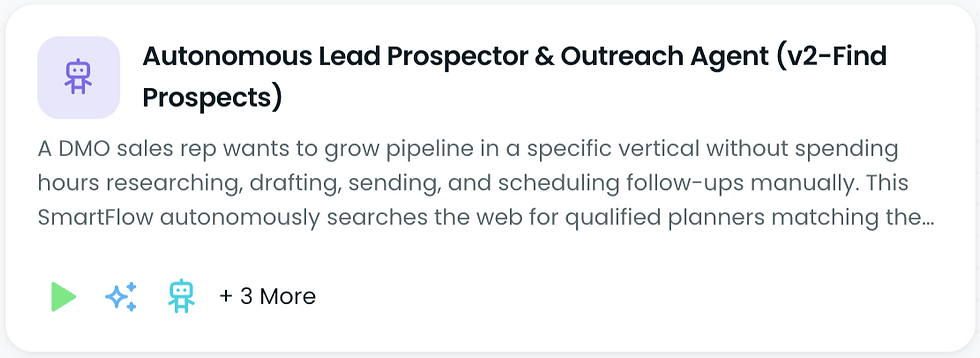
You tell it what you're after, say associations of five hundred to fifteen hundred people that are flexible on summer dates. It goes out to the open web, finds qualified groups you've never heard of, drafts a personalized first email for each one, and drops them into your pipeline tracker as drafts you review before anything sends. That's not a cold list you bought, it's one you built.

The second agent is a researcher.

This is the one for the spreadsheet from the show.
You drop your eighty names into a Google Sheet (or any spreadsheet) and run it. A few minutes later you get back a color-coded call sheet. Green means a strong fit for your city. Red means skip. Every green row already has the decision-maker, the event size and room nights, where the group has met before, whether there's an open RFP, and one line on why it fits. It even hands you a short summary of who to chase first.

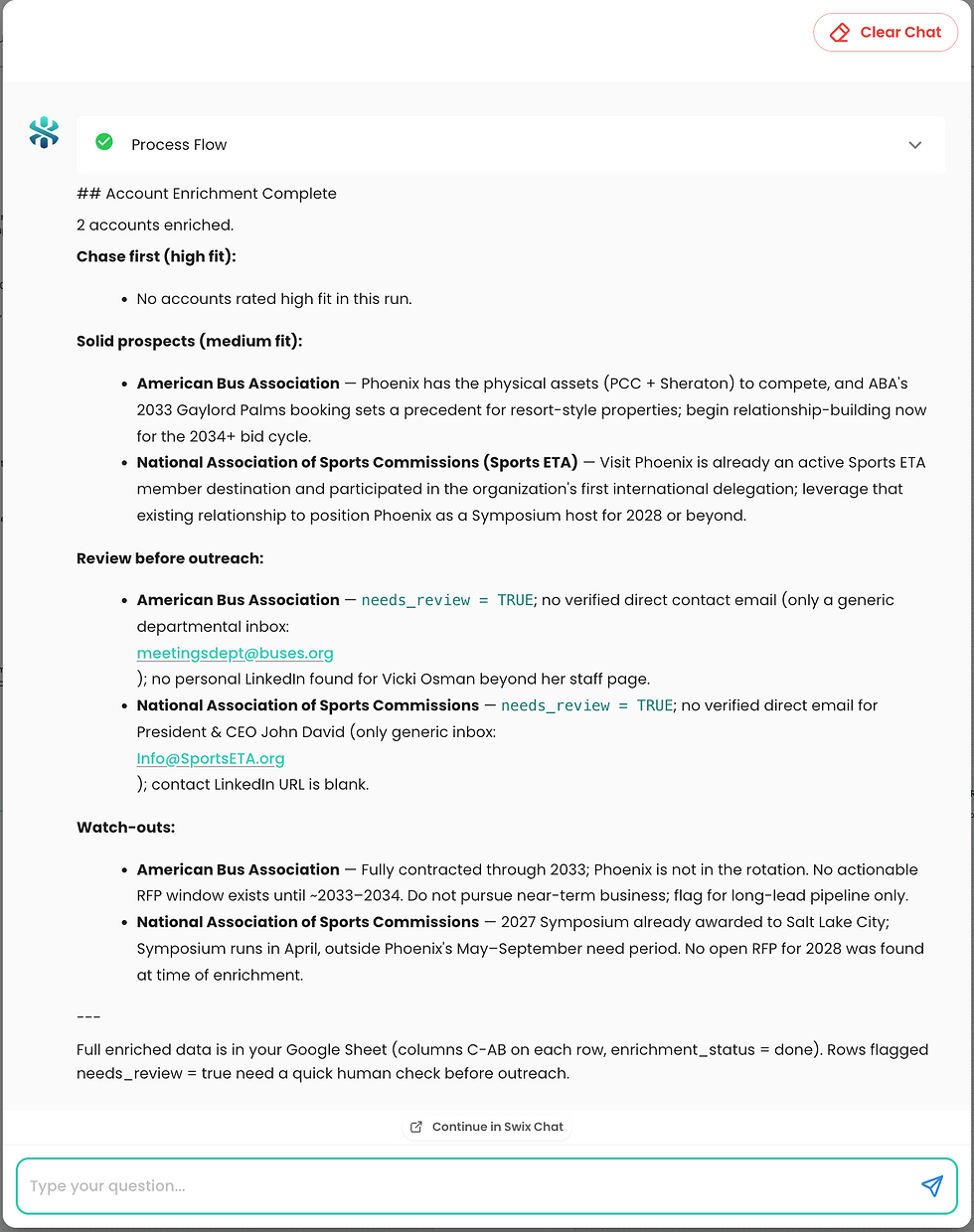
Here's one row from the (hard to see) screenshot above, the kind of thing it fills in for each name on your list:
National sports-events association. Annual symposium, about 1,200 attendees, roughly 3,000 room nights, meets every April. Rotates nationally; the 2028 host city is still open. Decision-maker: the president and CEO, with a link to where we found him. Fit: medium, because the dates sit just outside your priority window, but the size is right for your space. Hook: their CEO is based 20 minutes from your convention center.That's the part a rep would have spent half an hour digging up. Now it's sitting in a row.
So the prospector grows your list. The researcher tells you who on that list is worth your Monday morning.
What a week actually looks like
Monday, she opens the researcher's summary instead of a blank spreadsheet. Ten greens. She's got the planner's name for most of them and a hook for each.
She spends the week on conversations, not tabs. The groups that don't fit her city are already filtered out, so she's not burning time or a pitch on a citywide that needs three times her room block.
When she wants fresh names, the prospector is already filling the top of the funnel in the background, queuing drafts she reviews with her coffee.
That's the whole idea. Less time figuring out who to talk to. More time talking to them.
The part I care about most
The thing that makes or breaks a tool like this for a sales team is honesty.
The fastest way to lose a rep's trust is to hand them a contact, they email it, and it bounces. Or worse, it goes to the wrong person. Once that happens, they stop believing anything the tool tells them.
So we built the researcher to never guess. If it can't find a decision-maker's direct email on a real page, it leaves it blank and flags the row for a human to check. It won't build an address out of a name and a domain just to look complete.
You'll see honest blanks instead of bounced emails. For a sales team, that's not a weakness. That's the point. And if you already use something like Apollo or Clay for verified contacts, you can plug it into the agent and let it fill those in with even more accuracy.

What you get back
The math is simple. Researching one account by hand the right way is twenty to forty minutes. The agent does it in a couple of minutes. On a list of fifty names, that's ten to sixteen hours of someone's week handed back.
Across a full prospecting cycle, that's days. Days your reps spend selling instead of reading association websites at nine at night.
None of this replaces the rep. The judgment, the relationship, the actual sale, that's still all them. The agents clear the busywork that was eating the part of the job they're good at.
That feels like the right trade.
-Jason


