

Inside Swix AI
- FeaturesChat, assistants, automations and agents, built for destination teams.
- Agents (AI Workforce)An agent team that plans the work, does it, and checks in when a person has to decide.
- AI AutomationsQuickFlows, ActionFlows and SmartFlows for the work you repeat.
- AssistantsCustom assistants that know your role, your files and your voice.
- ChatAsk in plain words, get back reports, decks and dashboards.
- AI knowledge baseOne library of your files that everything in Swix reads from.
- Security & TrustHow your data is encrypted, isolated and never used to train outside AI models.
 In their words30 min“What used to take me hours now takes me 30 minutes tops.”Jenna McCormick · Destination Creative & Content Manager, Visit Cheyenne
 AgentsPlans the work, does it, and stops for your okay.
 AI AutomationsA monthly board report, drafted in five numbered steps.
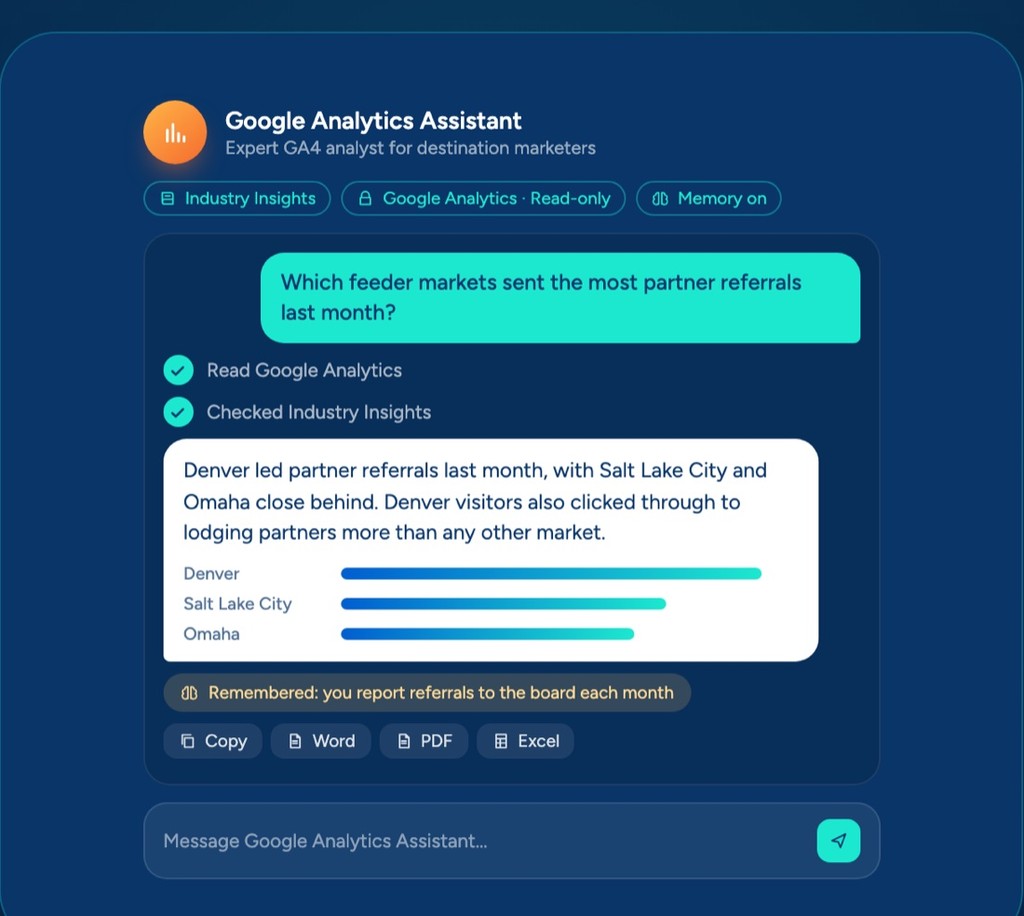 AssistantsAnswers from your Google Analytics, with read-only access.
 ChatOne prompt, a finished board report you can share.
 AI knowledge baseYour files, read by every assistant, agent and flow.
Swix AI
- Reading the inbox
- Drafting RFP replies
- Updating partner listings
- Agents on shift
- Swix
- AI
- Open
Home
BlogOct 29, 2026 · 6 min
None of Us Started as AI People
Every big shift in destination marketing started with “we’ll never do this.” AI is the next one, and the hesitation deserves real answers.

Key takeaways
- Social media, mobile and location data all started with “we’ll never do this” at a lot of DMOs. I think AI is the next one.
- Sojern’s 2026 survey of more than 350 DMOs found 66% already use AI to help with content, while 16% aren’t using it at all.
- Ask AI to show its sources, and click through the ones that matter before anything reaches your board or a partner.
- Use a business account your organization has approved, and check that your conversations aren’t being used to train the model.
- Make it a habit. Keep it on your home screen, and give it a shot before you start a task.
Back in 2010, a lot of DMOs were saying they'd never really do social media. Around 2015 it was mobile-first design. A couple of years after that, it was measuring beyond the click, using mobile location data to see who actually showed up in your destination. Every one of those shifts came with the same resistance and the same "we'll never do this."
Today all three are just part of the job for a lot of DMOs.
I think we're in the middle of the next one. Melyssa Reeves, who runs One West Tourism Alliance, shared recently that two years ago, the planning committee for their MarTech conference asked One West to stop scheduling AI sessions. This year, the same committee asked for more.
She also described where her members are right now. Some are all in, some are still afraid of it, and "a few go quiet the second the topic comes up on a call."
The industry numbers look pretty similar. Sojern's 2026 State of Destination Marketing report, which surveyed more than 350 DMOs, found 66% already use AI to help with content, and the share using it for data analysis went from 28% to 51%. Another 16% said they aren't using AI at all.
When it clicked for me
Nobody in this industry started as an AI person, and that includes me. I never really felt behind, but I do remember when it clicked.
A few years back, when I first saw custom GPTs (versions of ChatGPT you set up for one specific job), I built a little team of them around the roles you'd see on a marketing team. I used them regularly for marketing, strategy and a lot more. That was my aha moment, because I could finally see where this was going.
I talked about it at Destinations International's annual convention in Tampa in 2024. The room was packed, and a couple hundred people reached out afterward asking for a copy of them. That's when I really thought, this is big, and the next wave is coming.
The people who seem fluent now mostly just got their reps in. They used it a lot and got a feel for what it's good at and where it falls down. Microsoft's 2026 Work Trend Index, which surveyed 20,000 people who use AI at work, found 58% say they're producing work they couldn't have produced a year ago. Among the people Microsoft calls "frontier professionals," basically the ones furthest along, it's 80%.
And honestly, if you can write a clear email to a partner, I think you've already got most of what you need to work with AI.
The hesitation deserves real answers
Melyssa also wrote that "the hesitation deserves more respect than it usually gets," and I agree with her. She said people want to know two things, where the information comes from and what happens to the data they put in. That matters even more if a DMO acts on something the AI got wrong.
Here's where I'd start.
On where it comes from, ask it to show you its sources, then click through and check the ones that matter before anything goes in front of your board or a partner. Some tools can't look things up live, and a few will confidently make a source up, so the click-through is the important part.
On data, use a business account your organization has approved rather than a personal one, and check the settings or your plan's terms to make sure your conversations aren't being used to train the model. It also helps when your organization is clear about what can be shared with AI and what shouldn't be.
And if you want to go further, you can connect through your own API account (a direct, developer-style connection) with a provider that will agree to zero data retention, which means they don't keep what you send them. That's more technical, but it's there if you need it.
Why it's probably still worth starting now
I'd gently push you to start anyway, because the world doesn't care whether we feel ready.
I don't think AI is going to replace a good destination marketer, and so far the numbers lean that way too. In McKinsey's 2026 State of AI survey, about two-thirds of respondents said AI made little or no difference to their organization's total headcount over the past year. A year earlier, about a third of respondents had expected cuts. The job is still selling your destination and taking care of your partners. AI just changes how that work gets done.
Waiting it out probably isn't as safe as it feels, though. If you start now, you're taking control of your own future and making yourself more valuable, to your employer and in your own career.
Start with a habit
The way to get comfortable is to make it part of your day, so you're not relying on remembering it.
Put the app on your desktop or phone's home screen and pin it in your browser, so it's in front of you every day. Some assistants will even let you schedule a task so it reaches out to you first, which helps on the busy days when you'd forget.
And before you start something at your desk, give AI a shot at it first. Sometimes it won't help, and you'll learn something either way. Even when it can't solve the problem on its own, it's still a great sparring partner while you think it through.
Where to look on your own desk
If you're not sure what to try, I'd look in four places.
The thing you do every week the same way. The welcome email for every new partner, or the monthly occupancy recap. If you could write the steps on an index card, AI can probably take a big chunk of it off your plate.
The thing you'd do if you had one more person. Refreshing old blog posts, or actually personalizing your sales follow-ups. Plenty of DMOs have a long list of these, and I think it's where a lot of the real value is hiding.
The thing you keep putting off. The RFP response that's due Friday, the grant report, the awkward email to a partner who's behind on payment. That feeling of dread is a useful signal, because it usually means the task is boring or a little scary, and AI is really good at giving you a rough first draft to react to.
The thing you've never done before. Your first sponsorship deck, or a board presentation on a topic you're still learning. Plenty of people have done it before you and written about how it went, and AI has learned from much of that.
What it looks like when it catches on
I got to watch this happen recently with a director of visitor experience at a DMO we work with. Her homework was to build a simple flow or two (a flow is just a set of steps the AI runs for you). She did, and in under five minutes she built one that searches the web for local events missing from their events calendar. She tweaked it once, then handed it to a colleague on their content team who'd use it to keep the calendar complete. The next day, that colleague had built her own version and set it up to run on its own schedule.
That same colleague recently named her AI agents (helpers that can take on tasks for you) after Gru and the minions from Despicable Me, which made me smile.
If you're in the quiet group
I'm not going to tell you to go all in. I'd just remind you that a lot of us said we'd never really do social media, either.
If nobody on your team has gone first yet, it might as well be you.
-Jason
We build AI tools made specifically for DMOs at Swix AI. If you're just getting started and want a hand finding your first use, I'm always happy to talk.
Credit where it's due. Melyssa Reeves at One West Tourism Alliance shared the committee story in a recent LinkedIn post, and she's worth following if you work in destination marketing in the West. The DMO adoption figures are from Sojern's 2026 State of Destination Marketing report. The headcount figures are from McKinsey's State of AI research. The Work Trend Index figures are from Microsoft, as reported by Fast Company and republished by Inc.
Questions people ask
Is it safe to put DMO information into AI tools?
Use a business account your organization has approved, check the settings or your plan’s terms so your conversations aren’t used for training, and be clear as a team about what shouldn’t be shared. If you want more control, you can connect through your own API account with a provider that agrees to zero data retention, so they don’t keep what you send.
How do I know where AI got its information?
Ask it to show its sources, then click through the ones that matter. Some tools can’t look things up live, and a few will make a source up, so the click-through is the important part.
Where should a DMO team start with AI?
Start with a task you do every week the same way, or the one you keep putting off, and try it with AI before you start it yourself.
Will AI replace jobs at DMOs?
I don’t think AI is going to replace a good destination marketer, and so far the numbers lean that way too. In McKinsey’s 2026 State of AI survey, about two-thirds of respondents said AI made little or no difference to their organization’s total headcount over the past year. The job is still selling your destination and taking care of your partners.
BlogOct 29, 2026 · 6 min
None of Us Started as AI People
Every big shift in destination marketing started with “we’ll never do this.” AI is the next one, and the hesitation deserves real answers.
Key takeaways
- Social media, mobile and location data all started with “we’ll never do this” at a lot of DMOs. I think AI is the next one.
- Sojern’s 2026 survey of more than 350 DMOs found 66% already use AI to help with content, while 16% aren’t using it at all.
- Ask AI to show its sources, and click through the ones that matter before anything reaches your board or a partner.
- Use a business account your organization has approved, and check that your conversations aren’t being used to train the model.
- Make it a habit. Keep it on your home screen, and give it a shot before you start a task.
Back in 2010, a lot of DMOs were saying they'd never really do social media. Around 2015 it was mobile-first design. A couple of years after that, it was measuring beyond the click, using mobile location data to see who actually showed up in your destination. Every one of those shifts came with the same resistance and the same "we'll never do this."
Today all three are just part of the job for a lot of DMOs.
I think we're in the middle of the next one. Melyssa Reeves, who runs One West Tourism Alliance, shared recently that two years ago, the planning committee for their MarTech conference asked One West to stop scheduling AI sessions. This year, the same committee asked for more.
She also described where her members are right now. Some are all in, some are still afraid of it, and "a few go quiet the second the topic comes up on a call."
The industry numbers look pretty similar. Sojern's 2026 State of Destination Marketing report, which surveyed more than 350 DMOs, found 66% already use AI to help with content, and the share using it for data analysis went from 28% to 51%. Another 16% said they aren't using AI at all.
When it clicked for me
Nobody in this industry started as an AI person, and that includes me. I never really felt behind, but I do remember when it clicked.
A few years back, when I first saw custom GPTs (versions of ChatGPT you set up for one specific job), I built a little team of them around the roles you'd see on a marketing team. I used them regularly for marketing, strategy and a lot more. That was my aha moment, because I could finally see where this was going.
I talked about it at Destinations International's annual convention in Tampa in 2024. The room was packed, and a couple hundred people reached out afterward asking for a copy of them. That's when I really thought, this is big, and the next wave is coming.
The people who seem fluent now mostly just got their reps in. They used it a lot and got a feel for what it's good at and where it falls down. Microsoft's 2026 Work Trend Index, which surveyed 20,000 people who use AI at work, found 58% say they're producing work they couldn't have produced a year ago. Among the people Microsoft calls "frontier professionals," basically the ones furthest along, it's 80%.
And honestly, if you can write a clear email to a partner, I think you've already got most of what you need to work with AI.
The hesitation deserves real answers
Melyssa also wrote that "the hesitation deserves more respect than it usually gets," and I agree with her. She said people want to know two things, where the information comes from and what happens to the data they put in. That matters even more if a DMO acts on something the AI got wrong.
Here's where I'd start.
On where it comes from, ask it to show you its sources, then click through and check the ones that matter before anything goes in front of your board or a partner. Some tools can't look things up live, and a few will confidently make a source up, so the click-through is the important part.
On data, use a business account your organization has approved rather than a personal one, and check the settings or your plan's terms to make sure your conversations aren't being used to train the model. It also helps when your organization is clear about what can be shared with AI and what shouldn't be.
And if you want to go further, you can connect through your own API account (a direct, developer-style connection) with a provider that will agree to zero data retention, which means they don't keep what you send them. That's more technical, but it's there if you need it.
Why it's probably still worth starting now
I'd gently push you to start anyway, because the world doesn't care whether we feel ready.
I don't think AI is going to replace a good destination marketer, and so far the numbers lean that way too. In McKinsey's 2026 State of AI survey, about two-thirds of respondents said AI made little or no difference to their organization's total headcount over the past year. A year earlier, about a third of respondents had expected cuts. The job is still selling your destination and taking care of your partners. AI just changes how that work gets done.
Waiting it out probably isn't as safe as it feels, though. If you start now, you're taking control of your own future and making yourself more valuable, to your employer and in your own career.
Start with a habit
The way to get comfortable is to make it part of your day, so you're not relying on remembering it.
Put the app on your desktop or phone's home screen and pin it in your browser, so it's in front of you every day. Some assistants will even let you schedule a task so it reaches out to you first, which helps on the busy days when you'd forget.
And before you start something at your desk, give AI a shot at it first. Sometimes it won't help, and you'll learn something either way. Even when it can't solve the problem on its own, it's still a great sparring partner while you think it through.
Where to look on your own desk
If you're not sure what to try, I'd look in four places.
The thing you do every week the same way. The welcome email for every new partner, or the monthly occupancy recap. If you could write the steps on an index card, AI can probably take a big chunk of it off your plate.
The thing you'd do if you had one more person. Refreshing old blog posts, or actually personalizing your sales follow-ups. Plenty of DMOs have a long list of these, and I think it's where a lot of the real value is hiding.
The thing you keep putting off. The RFP response that's due Friday, the grant report, the awkward email to a partner who's behind on payment. That feeling of dread is a useful signal, because it usually means the task is boring or a little scary, and AI is really good at giving you a rough first draft to react to.
The thing you've never done before. Your first sponsorship deck, or a board presentation on a topic you're still learning. Plenty of people have done it before you and written about how it went, and AI has learned from much of that.
What it looks like when it catches on
I got to watch this happen recently with a director of visitor experience at a DMO we work with. Her homework was to build a simple flow or two (a flow is just a set of steps the AI runs for you). She did, and in under five minutes she built one that searches the web for local events missing from their events calendar. She tweaked it once, then handed it to a colleague on their content team who'd use it to keep the calendar complete. The next day, that colleague had built her own version and set it up to run on its own schedule.
That same colleague recently named her AI agents (helpers that can take on tasks for you) after Gru and the minions from Despicable Me, which made me smile.
If you're in the quiet group
I'm not going to tell you to go all in. I'd just remind you that a lot of us said we'd never really do social media, either.
If nobody on your team has gone first yet, it might as well be you.
-Jason
We build AI tools made specifically for DMOs at Swix AI. If you're just getting started and want a hand finding your first use, I'm always happy to talk.
Credit where it's due. Melyssa Reeves at One West Tourism Alliance shared the committee story in a recent LinkedIn post, and she's worth following if you work in destination marketing in the West. The DMO adoption figures are from Sojern's 2026 State of Destination Marketing report. The headcount figures are from McKinsey's State of AI research. The Work Trend Index figures are from Microsoft, as reported by Fast Company and republished by Inc.
Questions people ask
Is it safe to put DMO information into AI tools?
Use a business account your organization has approved, check the settings or your plan’s terms so your conversations aren’t used for training, and be clear as a team about what shouldn’t be shared. If you want more control, you can connect through your own API account with a provider that agrees to zero data retention, so they don’t keep what you send.
How do I know where AI got its information?
Ask it to show its sources, then click through the ones that matter. Some tools can’t look things up live, and a few will make a source up, so the click-through is the important part.
Where should a DMO team start with AI?
Start with a task you do every week the same way, or the one you keep putting off, and try it with AI before you start it yourself.
Will AI replace jobs at DMOs?
I don’t think AI is going to replace a good destination marketer, and so far the numbers lean that way too. In McKinsey’s 2026 State of AI survey, about two-thirds of respondents said AI made little or no difference to their organization’s total headcount over the past year. The job is still selling your destination and taking care of your partners.
BlogOct 29, 2026 · 6 min
Every big shift in destination marketing started with “we’ll never do this.” AI is the next one, and the hesitation deserves real answers.
Key takeaways
- Social media, mobile and location data all started with “we’ll never do this” at a lot of DMOs. I think AI is the next one.
- Sojern’s 2026 survey of more than 350 DMOs found 66% already use AI to help with content, while 16% aren’t using it at all.
- Ask AI to show its sources, and click through the ones that matter before anything reaches your board or a partner.
- Use a business account your organization has approved, and check that your conversations aren’t being used to train the model.
- Make it a habit. Keep it on your home screen, and give it a shot before you start a task.
Back in 2010, a lot of DMOs were saying they'd never really do social media. Around 2015 it was mobile-first design. A couple of years after that, it was measuring beyond the click, using mobile location data to see who actually showed up in your destination. Every one of those shifts came with the same resistance and the same "we'll never do this."
Today all three are just part of the job for a lot of DMOs.
I think we're in the middle of the next one. Melyssa Reeves, who runs One West Tourism Alliance, shared recently that two years ago, the planning committee for their MarTech conference asked One West to stop scheduling AI sessions. This year, the same committee asked for more.
She also described where her members are right now. Some are all in, some are still afraid of it, and "a few go quiet the second the topic comes up on a call."
The industry numbers look pretty similar. Sojern's 2026 State of Destination Marketing report, which surveyed more than 350 DMOs, found 66% already use AI to help with content, and the share using it for data analysis went from 28% to 51%. Another 16% said they aren't using AI at all.
When it clicked for me
Nobody in this industry started as an AI person, and that includes me. I never really felt behind, but I do remember when it clicked.
A few years back, when I first saw custom GPTs (versions of ChatGPT you set up for one specific job), I built a little team of them around the roles you'd see on a marketing team. I used them regularly for marketing, strategy and a lot more. That was my aha moment, because I could finally see where this was going.
I talked about it at Destinations International's annual convention in Tampa in 2024. The room was packed, and a couple hundred people reached out afterward asking for a copy of them. That's when I really thought, this is big, and the next wave is coming.
The people who seem fluent now mostly just got their reps in. They used it a lot and got a feel for what it's good at and where it falls down. Microsoft's 2026 Work Trend Index, which surveyed 20,000 people who use AI at work, found 58% say they're producing work they couldn't have produced a year ago. Among the people Microsoft calls "frontier professionals," basically the ones furthest along, it's 80%.
And honestly, if you can write a clear email to a partner, I think you've already got most of what you need to work with AI.
The hesitation deserves real answers
Melyssa also wrote that "the hesitation deserves more respect than it usually gets," and I agree with her. She said people want to know two things, where the information comes from and what happens to the data they put in. That matters even more if a DMO acts on something the AI got wrong.
Here's where I'd start.
On where it comes from, ask it to show you its sources, then click through and check the ones that matter before anything goes in front of your board or a partner. Some tools can't look things up live, and a few will confidently make a source up, so the click-through is the important part.
On data, use a business account your organization has approved rather than a personal one, and check the settings or your plan's terms to make sure your conversations aren't being used to train the model. It also helps when your organization is clear about what can be shared with AI and what shouldn't be.
And if you want to go further, you can connect through your own API account (a direct, developer-style connection) with a provider that will agree to zero data retention, which means they don't keep what you send them. That's more technical, but it's there if you need it.
Why it's probably still worth starting now
I'd gently push you to start anyway, because the world doesn't care whether we feel ready.
I don't think AI is going to replace a good destination marketer, and so far the numbers lean that way too. In McKinsey's 2026 State of AI survey, about two-thirds of respondents said AI made little or no difference to their organization's total headcount over the past year. A year earlier, about a third of respondents had expected cuts. The job is still selling your destination and taking care of your partners. AI just changes how that work gets done.
Waiting it out probably isn't as safe as it feels, though. If you start now, you're taking control of your own future and making yourself more valuable, to your employer and in your own career.
Start with a habit
The way to get comfortable is to make it part of your day, so you're not relying on remembering it.
Put the app on your desktop or phone's home screen and pin it in your browser, so it's in front of you every day. Some assistants will even let you schedule a task so it reaches out to you first, which helps on the busy days when you'd forget.
And before you start something at your desk, give AI a shot at it first. Sometimes it won't help, and you'll learn something either way. Even when it can't solve the problem on its own, it's still a great sparring partner while you think it through.
Where to look on your own desk
If you're not sure what to try, I'd look in four places.
The thing you do every week the same way. The welcome email for every new partner, or the monthly occupancy recap. If you could write the steps on an index card, AI can probably take a big chunk of it off your plate.
The thing you'd do if you had one more person. Refreshing old blog posts, or actually personalizing your sales follow-ups. Plenty of DMOs have a long list of these, and I think it's where a lot of the real value is hiding.
The thing you keep putting off. The RFP response that's due Friday, the grant report, the awkward email to a partner who's behind on payment. That feeling of dread is a useful signal, because it usually means the task is boring or a little scary, and AI is really good at giving you a rough first draft to react to.
The thing you've never done before. Your first sponsorship deck, or a board presentation on a topic you're still learning. Plenty of people have done it before you and written about how it went, and AI has learned from much of that.
What it looks like when it catches on
I got to watch this happen recently with a director of visitor experience at a DMO we work with. Her homework was to build a simple flow or two (a flow is just a set of steps the AI runs for you). She did, and in under five minutes she built one that searches the web for local events missing from their events calendar. She tweaked it once, then handed it to a colleague on their content team who'd use it to keep the calendar complete. The next day, that colleague had built her own version and set it up to run on its own schedule.
That same colleague recently named her AI agents (helpers that can take on tasks for you) after Gru and the minions from Despicable Me, which made me smile.
If you're in the quiet group
I'm not going to tell you to go all in. I'd just remind you that a lot of us said we'd never really do social media, either.
If nobody on your team has gone first yet, it might as well be you.
-Jason
We build AI tools made specifically for DMOs at Swix AI. If you're just getting started and want a hand finding your first use, I'm always happy to talk.
Credit where it's due. Melyssa Reeves at One West Tourism Alliance shared the committee story in a recent LinkedIn post, and she's worth following if you work in destination marketing in the West. The DMO adoption figures are from Sojern's 2026 State of Destination Marketing report. The headcount figures are from McKinsey's State of AI research. The Work Trend Index figures are from Microsoft, as reported by Fast Company and republished by Inc.
Questions people ask
Is it safe to put DMO information into AI tools?
Use a business account your organization has approved, check the settings or your plan’s terms so your conversations aren’t used for training, and be clear as a team about what shouldn’t be shared. If you want more control, you can connect through your own API account with a provider that agrees to zero data retention, so they don’t keep what you send.
How do I know where AI got its information?
Ask it to show its sources, then click through the ones that matter. Some tools can’t look things up live, and a few will make a source up, so the click-through is the important part.
Where should a DMO team start with AI?
Start with a task you do every week the same way, or the one you keep putting off, and try it with AI before you start it yourself.
Will AI replace jobs at DMOs?
I don’t think AI is going to replace a good destination marketer, and so far the numbers lean that way too. In McKinsey’s 2026 State of AI survey, about two-thirds of respondents said AI made little or no difference to their organization’s total headcount over the past year. The job is still selling your destination and taking care of your partners.
Book a demo
Ready when you are.
Tell us where the hours go. We'll show you Swix working on your destination's real work, and what your first 60 days would look like.
No slides. No obligation.
Book a demo
Ready when you are.
Tell us where the hours go. We'll show you Swix working on your destination's real work, and what your first 60 days would look like.
No slides. No obligation.