

Inside Swix AI
- FeaturesChat, assistants, automations and agents, built for destination teams.
- Agents (AI Workforce)An agent team that plans the work, does it, and checks in when a person has to decide.
- AI AutomationsQuickFlows, ActionFlows and SmartFlows for the work you repeat.
- AssistantsCustom assistants that know your role, your files and your voice.
- ChatAsk in plain words, get back reports, decks and dashboards.
- AI knowledge baseOne library of your files that everything in Swix reads from.
- Security & TrustHow your data is encrypted, isolated and never used to train outside AI models.
 In their words30 min“What used to take me hours now takes me 30 minutes tops.”Jenna McCormick · Destination Creative & Content Manager, Visit Cheyenne
 AgentsPlans the work, does it, and stops for your okay.
 AI AutomationsA monthly board report, drafted in five numbered steps.
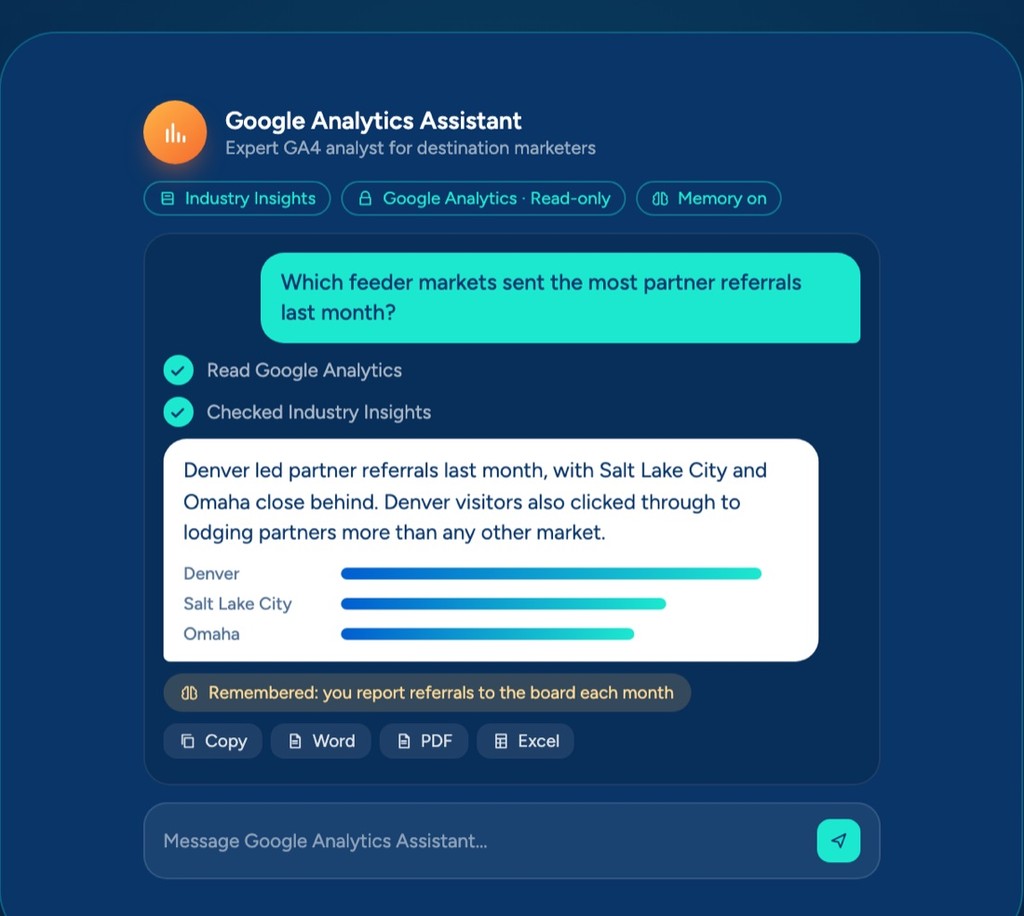 AssistantsAnswers from your Google Analytics, with read-only access.
 ChatOne prompt, a finished board report you can share.
 AI knowledge baseYour files, read by every assistant, agent and flow.
Swix AI
- Reading the inbox
- Drafting RFP replies
- Updating partner listings
- Agents on shift
- Swix
- AI
- Open
Home
BlogSep 8, 2026 · 6 min
Your CRM Runs Only Half Your Building
Every DMO evaluating AI asks if it connects to their CRM. That decides less than you think, because most of what eats your week never touches it.
Key takeaways
- Whether an AI tool connects to your CRM decides less than most DMOs expect, because a lot of the work that eats the week never touches it.
- Most destinations underuse the CRM they already pay for, so ask your account manager what's in there before you go shopping.
- HubSpot and Salesforce now let outside AI agents read and write records through their APIs, which is an early look at where destination platforms may head.
- The quickest wins sit in the messy middle between export and import, and some of them don't need AI at all.
"Does this integrate with our CRM?"
I get asked that from time to time. Sometimes the answer is yes, sometimes it's no, and I've come to think it decides less than the person asking is hoping it will.
You're probably underusing the one you have
Let me be fair to it first.
Your CRM is your system of record, and that's not a small job. It holds your accounts and contacts, tracks the convention business, runs a lot of your email, and keeps a history that survives some staff turnover. If you're on the meetings and sales side, it's the center of your working life and it should be.
It's also doing more than most teams realize. The major destination platforms handle partner and member management, dues and invoicing, sponsorships, an extranet where members maintain their own listings, email marketing, and reporting on top of all of it. If the only part of yours you've ever seen is the sales pipeline, there's a real conversation to have with your account manager about what else is in there.
So before anyone goes shopping, ask what you're already paying for and not using. That's the honest first question.
Now look at who's actually in it
Capability and use aren't the same thing. At a lot of destinations the CRM is in practice driven by the meetings and sales side. That's who it gets configured around, and everyone else touches it lightly if at all.
And even at a destination using every module it owns, there's a whole category of work the system was never meant to hold. The visitor guide someone is producing. The monthly events calendar rebuilt from an export. The board report assembled from five systems every quarter. The press trip brief. The partner newsletter. The last marketing campaign... you get the idea.
Almost none of that is CRM work. It's production work. Somebody is making a thing, and a system of record is built to hold records, not to make things. That's by design.
That's the gap. Your CRM does a real job, and it's not the job that's eating your week.
The biggest CRMs already settled this argument
Back to the integration question. Whether it's even possible has almost nothing to do with the AI tool you're evaluating. It depends on the platform you already own, and some are open about it while others publish no developer documentation or API at all.
This could easily read like me telling your vendor how to build software. That's not the case. It's that this stuff shows up at the big platforms first and reaches us later, so the quickest way to see what's coming is to look at what the two largest CRM companies already did.
Duncan Lennox, HubSpot's chief product and technology officer, wrote in May, "Some platforms will respond by closing down, constructing walled gardens, restricting access, and making it harder for customers to benefit from AI." His reasoning is practical rather than philosophical. "Agents don't click through dashboards or navigate interfaces; they call APIs, read structured outputs, and take action." And so, "anything you can do inside HubSpot, you should be able to do through an API."
Salesforce went further. In April, at their developer conference, co-founder Parker Harris introduced a release by asking, out loud, "Why should you ever log into Salesforce again?" Two days later CEO Marc Benioff was even more blunt about it on X. "No Browser Required! Our API is the UI."
They call it going headless. The plain version is that the whole platform is now reachable by other software directly, so an outside agent can now read and write your records, depending on your plan, without a human ever opening a browser.
That isn't positioning. They built it. HubSpot's MCP server reached general availability with write access in April. Salesforce's hosted MCP servers did the same month. Microsoft has one for Dynamics, and ServiceNow shipped one in May. MCP is worth thirty seconds of your time, because you'll keep hearing it. It's a standard way for AI tools to plug into software, the way USB became the standard way to plug in a device.
So at the two biggest CRMs on earth, an outside agent can now read and write your records without a human ever opening a browser. None of that is destination software, which is exactly why it's worth watching. You don't have to follow AI news to see where this is going. Watch what the big platforms ship, and you get an early look at the conversation you'll (hopefully) be having with your own vendor.
What that means for a destination
I'm not going to argue your destination platform should have shipped that yesterday. Those larger companies have thousands of engineers serving millions of customers. Our industry runs on a handful of vendors serving a few hundred organizations each. That's a real difference and it deserves some grace.
But it changes the question. "Does it integrate" stopped being a yes or no somewhere in the last eighteen months. The honest version is now a different question. What's the plan, and when? Your team already expects that from every other piece of software in their lives.
The work happens in the messy middle
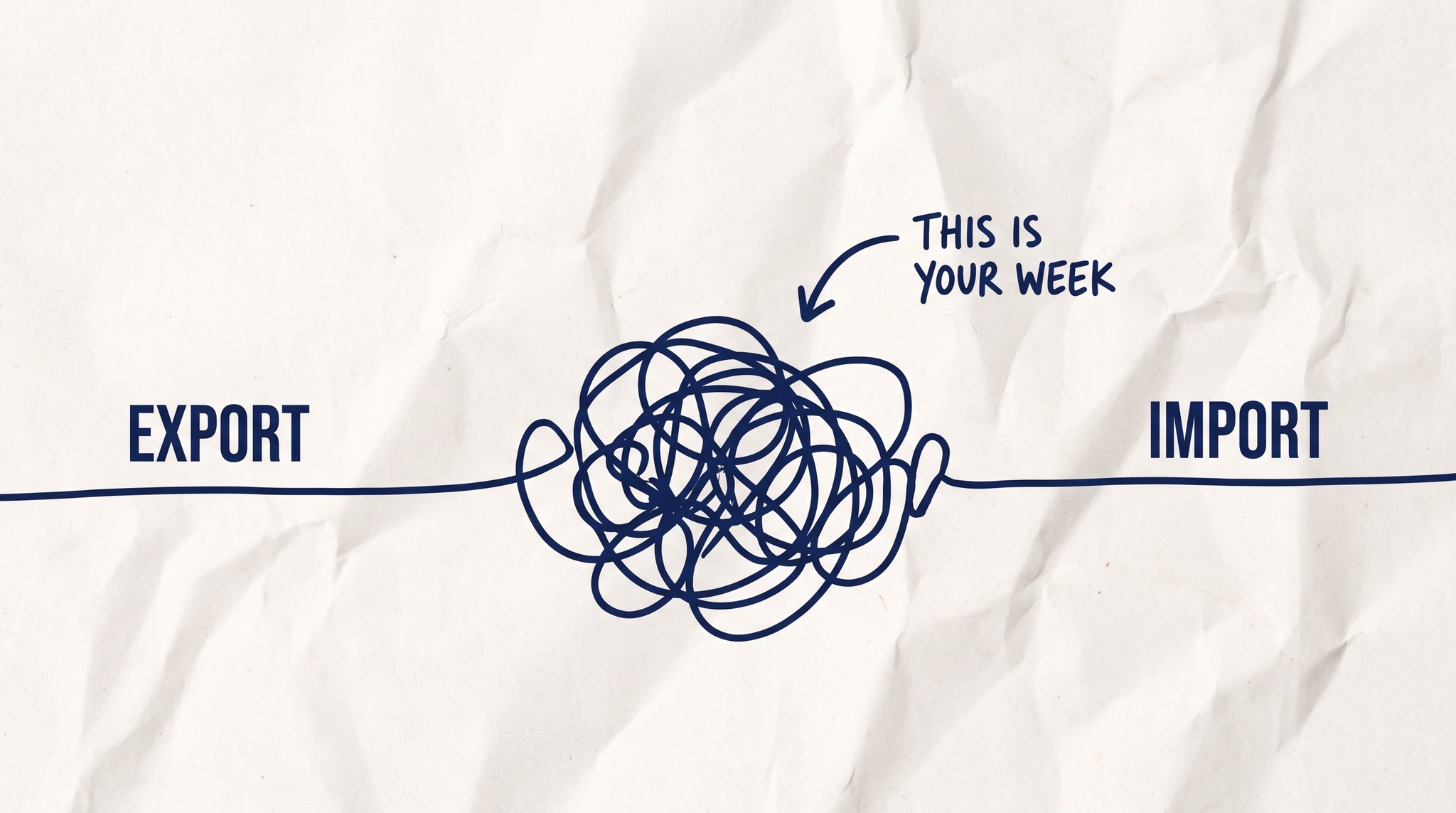
In my experience, a lot of destination work runs like this. An export, then the work, then a re-import. The middle is where the time goes. Somebody downloads a file.
Somebody opens three spreadsheets from three different places that don't agree with each other. Somebody merges address fields, checks duplicates, renames columns, and wrestles the whole thing into the shape the system will accept. Then somebody, eventually, uploads it.
None of that needs a connection to fix (although it would help a ton). And if your platform is one of the closed ones, the export is your door. Most systems that won't let anything write in will still let you get data out.
What that looked like for one DMO team
A creative and content manager we work with had a version of this. Three sources sending her contact lists, three different formats, none of them matching what her system would accept, and her job was to make them agree. She called it bottom-of-the-list work, which is exactly the kind of thing that gets put off, which means it piles up, which makes it worse the next time.
A normal batch took her two to three hours of soul-sucking work.
So, we built her an automation. She uploads the three files, it does the reformatting, and she gets back exactly what she needs to import. It takes about five seconds to run.
When we tested it against her real files, 174 rows, then 13, then 36, the output for one source came back byte for byte identical to the file she'd been cleaning by hand. Same result, without taking an afternoon.
Nothing in that touches her CRM. It sits entirely in the middle.
The part I didn't expect
That automation has no AI in it. Not one model call.
We're an AI company, so you'd reasonably expect me to work AI into everything I touch. But there are automations and there are AI automations, and they aren't the same thing. We use AI when it makes sense and we don't "engineer it in" just to say it's there. The right solution is often the simplest one that gets the task done accurately. If that needs AI, great. If it doesn't, that's okay too.
With contact data that has to be accurate every time, it wasn't close. Ask a language model to reshape 174 rows and sooner or later it drops one, or invents one, or helpfully "corrects" a zip code that was already right. So we wrote plain code into the automation so it does the same thing the same way every time.
Which matters when you're the one buying.
More AI is not the same thing as a better answer.
What I'd take away from this
Your CRM is a good system of record and it likely runs half your building. Keep it, use more of it, and ask it for an export.
Just don't let a yes or no about connecting to it decide what your team can do with AI, because the other half of your building was never waiting on that answer. Most of what eats your week is happening in the messy middle, where nothing is connected to anything, and that part you can start on this month.
-Jason
We build AI tools made specifically for destination marketing teams at Swix AI. If any of this resonates and you want to see what it looks like in practice, I'm happy to show you.
Questions people ask
Does an AI tool need to integrate with our CRM to be useful?
Not always. A lot of DMO work, like visitor guides, board reports and press trip briefs, is production work that happens outside the CRM. If your platform is closed, an export is usually still available, and that's enough to start.
What does it mean when a CRM goes headless?
The whole platform can be reached by other software directly through its API, so an outside agent can read and write records without anyone opening a browser. HubSpot and Salesforce have both done this and released MCP servers.
What is MCP in AI?
MCP is a standard way for AI tools to plug into software, a bit like USB became the standard way to plug in a device. HubSpot, Salesforce, Microsoft Dynamics and ServiceNow all have MCP servers now.
Should a DMO use AI to clean up contact lists?
For data that has to be right every time, plain code is often the better choice. In this post, an automation with no AI in it turned a two to three hour cleanup into about five seconds, and its output for one source matched the hand-cleaned file byte for byte.
BlogSep 8, 2026 · 6 min
Your CRM Runs Only Half Your Building
Every DMO evaluating AI asks if it connects to their CRM. That decides less than you think, because most of what eats your week never touches it.
Key takeaways
- Whether an AI tool connects to your CRM decides less than most DMOs expect, because a lot of the work that eats the week never touches it.
- Most destinations underuse the CRM they already pay for, so ask your account manager what's in there before you go shopping.
- HubSpot and Salesforce now let outside AI agents read and write records through their APIs, which is an early look at where destination platforms may head.
- The quickest wins sit in the messy middle between export and import, and some of them don't need AI at all.
"Does this integrate with our CRM?"
I get asked that from time to time. Sometimes the answer is yes, sometimes it's no, and I've come to think it decides less than the person asking is hoping it will.
You're probably underusing the one you have
Let me be fair to it first.
Your CRM is your system of record, and that's not a small job. It holds your accounts and contacts, tracks the convention business, runs a lot of your email, and keeps a history that survives some staff turnover. If you're on the meetings and sales side, it's the center of your working life and it should be.
It's also doing more than most teams realize. The major destination platforms handle partner and member management, dues and invoicing, sponsorships, an extranet where members maintain their own listings, email marketing, and reporting on top of all of it. If the only part of yours you've ever seen is the sales pipeline, there's a real conversation to have with your account manager about what else is in there.
So before anyone goes shopping, ask what you're already paying for and not using. That's the honest first question.
Now look at who's actually in it
Capability and use aren't the same thing. At a lot of destinations the CRM is in practice driven by the meetings and sales side. That's who it gets configured around, and everyone else touches it lightly if at all.
And even at a destination using every module it owns, there's a whole category of work the system was never meant to hold. The visitor guide someone is producing. The monthly events calendar rebuilt from an export. The board report assembled from five systems every quarter. The press trip brief. The partner newsletter. The last marketing campaign... you get the idea.
Almost none of that is CRM work. It's production work. Somebody is making a thing, and a system of record is built to hold records, not to make things. That's by design.
That's the gap. Your CRM does a real job, and it's not the job that's eating your week.
The biggest CRMs already settled this argument
Back to the integration question. Whether it's even possible has almost nothing to do with the AI tool you're evaluating. It depends on the platform you already own, and some are open about it while others publish no developer documentation or API at all.
This could easily read like me telling your vendor how to build software. That's not the case. It's that this stuff shows up at the big platforms first and reaches us later, so the quickest way to see what's coming is to look at what the two largest CRM companies already did.
Duncan Lennox, HubSpot's chief product and technology officer, wrote in May, "Some platforms will respond by closing down, constructing walled gardens, restricting access, and making it harder for customers to benefit from AI." His reasoning is practical rather than philosophical. "Agents don't click through dashboards or navigate interfaces; they call APIs, read structured outputs, and take action." And so, "anything you can do inside HubSpot, you should be able to do through an API."
Salesforce went further. In April, at their developer conference, co-founder Parker Harris introduced a release by asking, out loud, "Why should you ever log into Salesforce again?" Two days later CEO Marc Benioff was even more blunt about it on X. "No Browser Required! Our API is the UI."
They call it going headless. The plain version is that the whole platform is now reachable by other software directly, so an outside agent can now read and write your records, depending on your plan, without a human ever opening a browser.
That isn't positioning. They built it. HubSpot's MCP server reached general availability with write access in April. Salesforce's hosted MCP servers did the same month. Microsoft has one for Dynamics, and ServiceNow shipped one in May. MCP is worth thirty seconds of your time, because you'll keep hearing it. It's a standard way for AI tools to plug into software, the way USB became the standard way to plug in a device.
So at the two biggest CRMs on earth, an outside agent can now read and write your records without a human ever opening a browser. None of that is destination software, which is exactly why it's worth watching. You don't have to follow AI news to see where this is going. Watch what the big platforms ship, and you get an early look at the conversation you'll (hopefully) be having with your own vendor.
What that means for a destination
I'm not going to argue your destination platform should have shipped that yesterday. Those larger companies have thousands of engineers serving millions of customers. Our industry runs on a handful of vendors serving a few hundred organizations each. That's a real difference and it deserves some grace.
But it changes the question. "Does it integrate" stopped being a yes or no somewhere in the last eighteen months. The honest version is now a different question. What's the plan, and when? Your team already expects that from every other piece of software in their lives.
The work happens in the messy middle
In my experience, a lot of destination work runs like this. An export, then the work, then a re-import. The middle is where the time goes. Somebody downloads a file.
Somebody opens three spreadsheets from three different places that don't agree with each other. Somebody merges address fields, checks duplicates, renames columns, and wrestles the whole thing into the shape the system will accept. Then somebody, eventually, uploads it.
None of that needs a connection to fix (although it would help a ton). And if your platform is one of the closed ones, the export is your door. Most systems that won't let anything write in will still let you get data out.
What that looked like for one DMO team
A creative and content manager we work with had a version of this. Three sources sending her contact lists, three different formats, none of them matching what her system would accept, and her job was to make them agree. She called it bottom-of-the-list work, which is exactly the kind of thing that gets put off, which means it piles up, which makes it worse the next time.
A normal batch took her two to three hours of soul-sucking work.
So, we built her an automation. She uploads the three files, it does the reformatting, and she gets back exactly what she needs to import. It takes about five seconds to run.
When we tested it against her real files, 174 rows, then 13, then 36, the output for one source came back byte for byte identical to the file she'd been cleaning by hand. Same result, without taking an afternoon.
Nothing in that touches her CRM. It sits entirely in the middle.
The part I didn't expect
That automation has no AI in it. Not one model call.
We're an AI company, so you'd reasonably expect me to work AI into everything I touch. But there are automations and there are AI automations, and they aren't the same thing. We use AI when it makes sense and we don't "engineer it in" just to say it's there. The right solution is often the simplest one that gets the task done accurately. If that needs AI, great. If it doesn't, that's okay too.
With contact data that has to be accurate every time, it wasn't close. Ask a language model to reshape 174 rows and sooner or later it drops one, or invents one, or helpfully "corrects" a zip code that was already right. So we wrote plain code into the automation so it does the same thing the same way every time.
Which matters when you're the one buying.
More AI is not the same thing as a better answer.
What I'd take away from this
Your CRM is a good system of record and it likely runs half your building. Keep it, use more of it, and ask it for an export.
Just don't let a yes or no about connecting to it decide what your team can do with AI, because the other half of your building was never waiting on that answer. Most of what eats your week is happening in the messy middle, where nothing is connected to anything, and that part you can start on this month.
-Jason
We build AI tools made specifically for destination marketing teams at Swix AI. If any of this resonates and you want to see what it looks like in practice, I'm happy to show you.
Questions people ask
Does an AI tool need to integrate with our CRM to be useful?
Not always. A lot of DMO work, like visitor guides, board reports and press trip briefs, is production work that happens outside the CRM. If your platform is closed, an export is usually still available, and that's enough to start.
What does it mean when a CRM goes headless?
The whole platform can be reached by other software directly through its API, so an outside agent can read and write records without anyone opening a browser. HubSpot and Salesforce have both done this and released MCP servers.
What is MCP in AI?
MCP is a standard way for AI tools to plug into software, a bit like USB became the standard way to plug in a device. HubSpot, Salesforce, Microsoft Dynamics and ServiceNow all have MCP servers now.
Should a DMO use AI to clean up contact lists?
For data that has to be right every time, plain code is often the better choice. In this post, an automation with no AI in it turned a two to three hour cleanup into about five seconds, and its output for one source matched the hand-cleaned file byte for byte.
BlogSep 8, 2026 · 6 min
Every DMO evaluating AI asks if it connects to their CRM. That decides less than you think, because most of what eats your week never touches it.
Key takeaways
- Whether an AI tool connects to your CRM decides less than most DMOs expect, because a lot of the work that eats the week never touches it.
- Most destinations underuse the CRM they already pay for, so ask your account manager what's in there before you go shopping.
- HubSpot and Salesforce now let outside AI agents read and write records through their APIs, which is an early look at where destination platforms may head.
- The quickest wins sit in the messy middle between export and import, and some of them don't need AI at all.
"Does this integrate with our CRM?"
I get asked that from time to time. Sometimes the answer is yes, sometimes it's no, and I've come to think it decides less than the person asking is hoping it will.
You're probably underusing the one you have
Let me be fair to it first.
Your CRM is your system of record, and that's not a small job. It holds your accounts and contacts, tracks the convention business, runs a lot of your email, and keeps a history that survives some staff turnover. If you're on the meetings and sales side, it's the center of your working life and it should be.
It's also doing more than most teams realize. The major destination platforms handle partner and member management, dues and invoicing, sponsorships, an extranet where members maintain their own listings, email marketing, and reporting on top of all of it. If the only part of yours you've ever seen is the sales pipeline, there's a real conversation to have with your account manager about what else is in there.
So before anyone goes shopping, ask what you're already paying for and not using. That's the honest first question.
Now look at who's actually in it
Capability and use aren't the same thing. At a lot of destinations the CRM is in practice driven by the meetings and sales side. That's who it gets configured around, and everyone else touches it lightly if at all.
And even at a destination using every module it owns, there's a whole category of work the system was never meant to hold. The visitor guide someone is producing. The monthly events calendar rebuilt from an export. The board report assembled from five systems every quarter. The press trip brief. The partner newsletter. The last marketing campaign... you get the idea.
Almost none of that is CRM work. It's production work. Somebody is making a thing, and a system of record is built to hold records, not to make things. That's by design.
That's the gap. Your CRM does a real job, and it's not the job that's eating your week.
The biggest CRMs already settled this argument
Back to the integration question. Whether it's even possible has almost nothing to do with the AI tool you're evaluating. It depends on the platform you already own, and some are open about it while others publish no developer documentation or API at all.
This could easily read like me telling your vendor how to build software. That's not the case. It's that this stuff shows up at the big platforms first and reaches us later, so the quickest way to see what's coming is to look at what the two largest CRM companies already did.
Duncan Lennox, HubSpot's chief product and technology officer, wrote in May, "Some platforms will respond by closing down, constructing walled gardens, restricting access, and making it harder for customers to benefit from AI." His reasoning is practical rather than philosophical. "Agents don't click through dashboards or navigate interfaces; they call APIs, read structured outputs, and take action." And so, "anything you can do inside HubSpot, you should be able to do through an API."
Salesforce went further. In April, at their developer conference, co-founder Parker Harris introduced a release by asking, out loud, "Why should you ever log into Salesforce again?" Two days later CEO Marc Benioff was even more blunt about it on X. "No Browser Required! Our API is the UI."
They call it going headless. The plain version is that the whole platform is now reachable by other software directly, so an outside agent can now read and write your records, depending on your plan, without a human ever opening a browser.
That isn't positioning. They built it. HubSpot's MCP server reached general availability with write access in April. Salesforce's hosted MCP servers did the same month. Microsoft has one for Dynamics, and ServiceNow shipped one in May. MCP is worth thirty seconds of your time, because you'll keep hearing it. It's a standard way for AI tools to plug into software, the way USB became the standard way to plug in a device.
So at the two biggest CRMs on earth, an outside agent can now read and write your records without a human ever opening a browser. None of that is destination software, which is exactly why it's worth watching. You don't have to follow AI news to see where this is going. Watch what the big platforms ship, and you get an early look at the conversation you'll (hopefully) be having with your own vendor.
What that means for a destination
I'm not going to argue your destination platform should have shipped that yesterday. Those larger companies have thousands of engineers serving millions of customers. Our industry runs on a handful of vendors serving a few hundred organizations each. That's a real difference and it deserves some grace.
But it changes the question. "Does it integrate" stopped being a yes or no somewhere in the last eighteen months. The honest version is now a different question. What's the plan, and when? Your team already expects that from every other piece of software in their lives.
The work happens in the messy middle
In my experience, a lot of destination work runs like this. An export, then the work, then a re-import. The middle is where the time goes. Somebody downloads a file.
Somebody opens three spreadsheets from three different places that don't agree with each other. Somebody merges address fields, checks duplicates, renames columns, and wrestles the whole thing into the shape the system will accept. Then somebody, eventually, uploads it.
None of that needs a connection to fix (although it would help a ton). And if your platform is one of the closed ones, the export is your door. Most systems that won't let anything write in will still let you get data out.
What that looked like for one DMO team
A creative and content manager we work with had a version of this. Three sources sending her contact lists, three different formats, none of them matching what her system would accept, and her job was to make them agree. She called it bottom-of-the-list work, which is exactly the kind of thing that gets put off, which means it piles up, which makes it worse the next time.
A normal batch took her two to three hours of soul-sucking work.
So, we built her an automation. She uploads the three files, it does the reformatting, and she gets back exactly what she needs to import. It takes about five seconds to run.
When we tested it against her real files, 174 rows, then 13, then 36, the output for one source came back byte for byte identical to the file she'd been cleaning by hand. Same result, without taking an afternoon.
Nothing in that touches her CRM. It sits entirely in the middle.
The part I didn't expect
That automation has no AI in it. Not one model call.
We're an AI company, so you'd reasonably expect me to work AI into everything I touch. But there are automations and there are AI automations, and they aren't the same thing. We use AI when it makes sense and we don't "engineer it in" just to say it's there. The right solution is often the simplest one that gets the task done accurately. If that needs AI, great. If it doesn't, that's okay too.
With contact data that has to be accurate every time, it wasn't close. Ask a language model to reshape 174 rows and sooner or later it drops one, or invents one, or helpfully "corrects" a zip code that was already right. So we wrote plain code into the automation so it does the same thing the same way every time.
Which matters when you're the one buying.
More AI is not the same thing as a better answer.
What I'd take away from this
Your CRM is a good system of record and it likely runs half your building. Keep it, use more of it, and ask it for an export.
Just don't let a yes or no about connecting to it decide what your team can do with AI, because the other half of your building was never waiting on that answer. Most of what eats your week is happening in the messy middle, where nothing is connected to anything, and that part you can start on this month.
-Jason
We build AI tools made specifically for destination marketing teams at Swix AI. If any of this resonates and you want to see what it looks like in practice, I'm happy to show you.
Questions people ask
Does an AI tool need to integrate with our CRM to be useful?
Not always. A lot of DMO work, like visitor guides, board reports and press trip briefs, is production work that happens outside the CRM. If your platform is closed, an export is usually still available, and that's enough to start.
What does it mean when a CRM goes headless?
The whole platform can be reached by other software directly through its API, so an outside agent can read and write records without anyone opening a browser. HubSpot and Salesforce have both done this and released MCP servers.
What is MCP in AI?
MCP is a standard way for AI tools to plug into software, a bit like USB became the standard way to plug in a device. HubSpot, Salesforce, Microsoft Dynamics and ServiceNow all have MCP servers now.
Should a DMO use AI to clean up contact lists?
For data that has to be right every time, plain code is often the better choice. In this post, an automation with no AI in it turned a two to three hour cleanup into about five seconds, and its output for one source matched the hand-cleaned file byte for byte.
Book a demo
Ready when you are.
Tell us where the hours go. We'll show you Swix working on your destination's real work, and what your first 60 days would look like.
No slides. No obligation.
Book a demo
Ready when you are.
Tell us where the hours go. We'll show you Swix working on your destination's real work, and what your first 60 days would look like.
No slides. No obligation.