
What If Your Entire Press Trip Package Built Itself?


Every press trip starts the same way.
A travel writer says yes. Maria, the comms director, opens a blank document, pulls out the last brief she built, and starts copying and pasting. She has to research the writer's recent coverage, draft the day-by-day itinerary, write a pitch email, draft ten or twelve partner coordination emails, build the internal brief deck for her director and CEO, and prepare the post-trip follow-up plan.
Most of it follows the same shape every time. The strategic decisions take fifteen minutes. The assembly takes the better part of two days.
This is the third and final edition in our series on building your first AI agent. We've covered leadership and the board report. We've covered marketing and the social media calendar. This week is communications. Specifically Maria's two days.
Two days of assembly. About to get a lot shorter.
What We're Building
The FAM Trip Brief Builder is an AI agent built specifically for DMO communications teams.
You fill in a short form about your guest: their name, outlet, trip dates, primary goals, and the key experiences you want to include. The agent does the rest.
It researches the journalist or creator from public sources and builds a profile of their editorial lens, their audience, and their recent coverage. It pulls the right partner properties from your destination's Knowledge Base. It classifies the guest type (editorial journalist, visual creator, group press tour, or tour operator) and tunes the entire brief to match. Editorial writers get pacing built around depth and quiet observation time. Visual creators get shot lists and golden hour scheduling.
What comes back, ready in your Google Drive and Gmail in about five minutes:
A branded internal press deck with the strategic context your CEO wants to see, plus a day-by-day itinerary with talking points and photo opportunities for every stop. A clean journalist-facing itinerary document. A pre-trip pitch email drafted in your brand voice and tuned to the writer's audience. And a personalized coordination email queued in Gmail for every partner property: hotel GMs, chefs, attraction directors, tour guides. Each one with the comp ask, the dietary notes, and the photo-op offer already written.
Maria reviews, tightens her favorite sentences, sends. The trip goes from idea to fully briefed in the time it used to take her to research one writer.
Step by Step — Here's How to Build It
Step 1: Choose the right tool for the job.
Head to the template library and search "FAM Trip." You'll find the FAM Trip Brief Builder Agent already built and ready to customize. You're not starting from scratch. The hard work is already done.

Before you run it for the first time, make sure your destination's partner properties are loaded into your Knowledge Base. Hotels, restaurants, attractions, tour operators. The agent pulls from this to match the right experiences to each guest's editorial focus. The more complete your Knowledge Base, the better the itinerary it builds.
Step 2: Fill in the guest details.
Open the agent. You'll see a straightforward form: who is the guest, what outlet do they write for, what are the trip dates, what are the primary goals, which experiences are available, and any dietary or logistical notes.
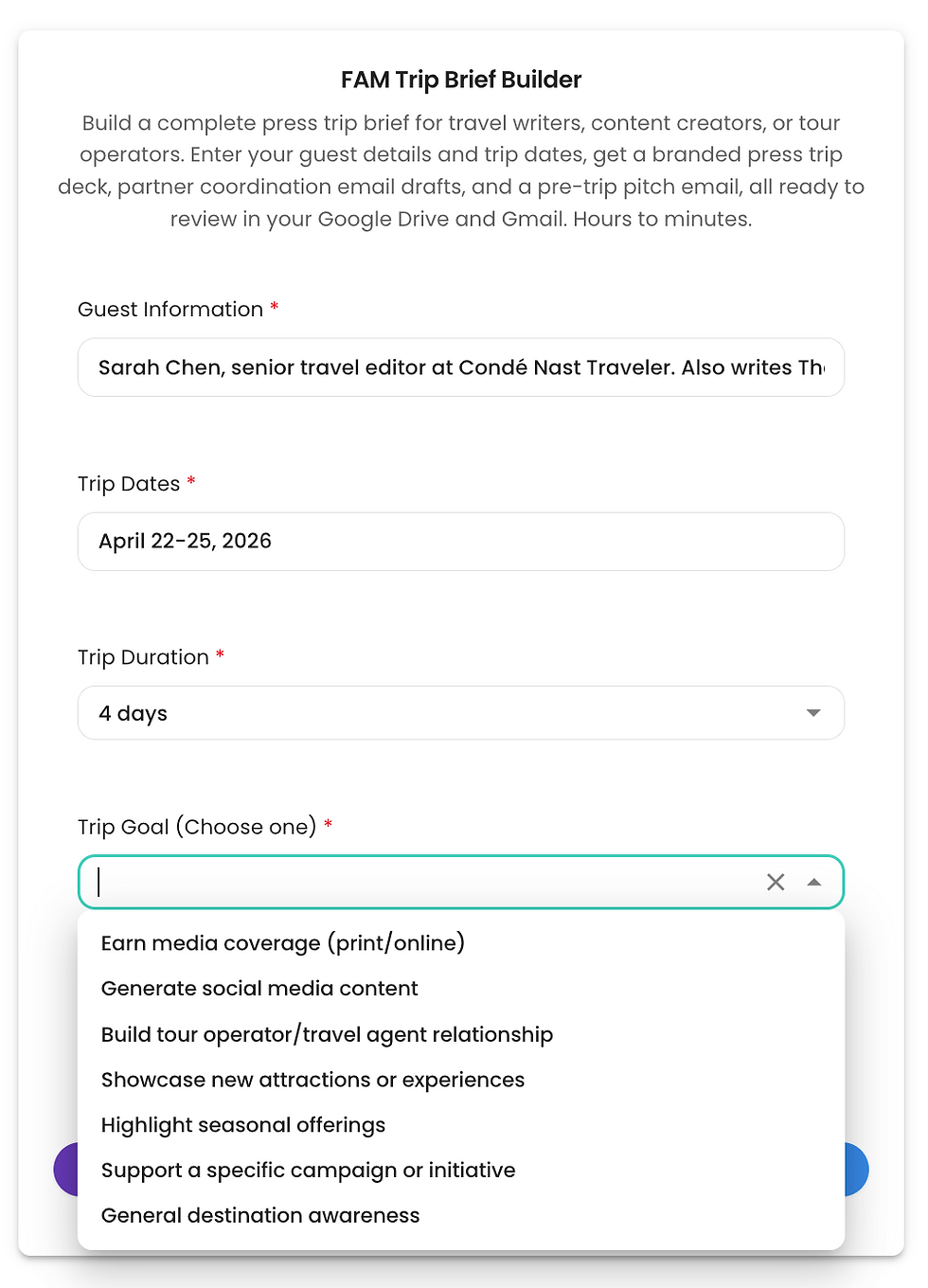
The trip goals dropdown matters. "Earn media coverage" produces a different brief than "generate social media content" or "build tour operator relationship."
The agent uses this to tune the pacing, the talking points, and the partner ask for every stop.
Step 3: Review and send.
The agent runs through multiple steps automatically, generating the content, creating the deck, and drafting every email. Most teams get to something genuinely usable on the first run. You still review it, adjust the framing, and bring your relationship knowledge to the final version. But you're editing instead of building from scratch. That's the whole trade.
What the Output Looks Like
Here's where this agent separates itself from the previous two in the series. The output isn't one document. It's an entire press trip package.

The press deck is built for the people inside your organization: the director, the CEO, the board. They want to know why this trip matters and what success looks like. The deck gives them the strategic context, the guest's audience profile, and the coverage value benchmark alongside the day-by-day itinerary.
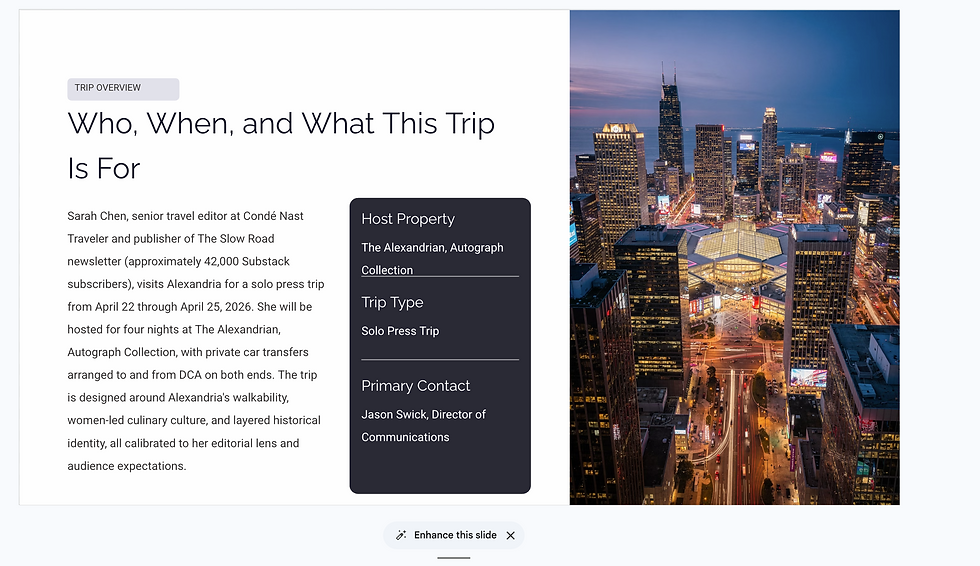
The journalist-facing itinerary is a completely different document. It's warm, hospitality-focused, and written for the writer, not the internal stakeholder. It gives them the practical details they need while communicating that the trip was designed around them specifically. You can view the full sample document here.

Then there's the Gmail inbox:

Each partner email is personalized. The email to the restaurant chef reads differently from the email to the museum director. The comp ask, the dietary notes, the framing of the media opportunity: all of it is tuned to the type of partner receiving it.

And then the notification email arrives in your inbox with links to everything: the deck, the itinerary document, and a count of all the drafts waiting for your review.

For this example, a four-day press trip for a travel writer from Condé Nast Traveler, the agent produced a branded presentation deck, a full journalist-facing itinerary, one pre-trip pitch email, and 16 individual partner coordination emails. All drafted. All in Gmail. All ready to review and send.
That's what used to take two days.
Let's Put That in Perspective
One form. About five minutes of input.
What you got back: a branded internal press deck, a journalist-facing itinerary document, a pre-trip pitch email tuned to the writer's editorial voice, and a personalized coordination email for every partner on the trip, all in your Google Drive and Gmail.
What it replaced: researching the writer, drafting the itinerary from scratch, writing the pitch email, building the deck, and composing ten to sixteen individual partner emails. All the assembly work that follows the same shape every time regardless of who the guest is.
For a DMO running ten press trips a year, that's roughly 30-50 hours back in the comms team's calendar. For a DMO running twenty-five trips, ithat's weeks of staff time back in your calendar every year.
None of it replaces the judgment that makes a press trip actually work. The trip strategy, the partner relationships, the editorial fit calls: those stay with Maria.
What the agent replaces is the assembly. The blank page. The repetitive copy work that has nothing to do with why she got into this job.
Same brief quality, same editorial polish, fraction of the time.
What to Do After It Works
Run it on your next real press trip. Not a test scenario. A real guest, real partner properties, real trip dates. The output will be meaningfully better and you'll know immediately whether it's changing how your team works.
Then show the person who builds every press trip brief what just happened. That conversation is probably the most important thing you can do. Not a training session. Not a team announcement. Just one person seeing it work on something real.
The Series Is Done. Here's What We Built.
Three editions. Three departments. Three agents.
Edition 6 was for leadership: a board report workflow that turns a half-day assembly task into minutes.
Edition 7 was for marketing: a social media calendar agent that writes a full week of content, a visual creative brief, and emails your team before Monday morning starts.
Edition 8 is for communications: a press trip agent that turns two days of assembly into five minutes of input.
If you built all three, you have AI working across your organization right now. Not in theory. Not in a pilot. Actually running, producing real output, giving real hours back to real people on your team.
That's a different organization than the one you started with three weeks ago.
The next question isn't whether AI can help your DMO. You already know it can. The next question is what you build next.
More soon.
-Jason
I write about AI and destination marketing for DMO professionals. If you want pieces like this a few days before they go public, you can join the early access list at https://www.swix.ai/#insider


