
Inside Swix AI
- FeaturesChat, assistants, automations and agents, built for destination teams.
- Agents (AI Workforce)An agent team that plans the work, does it, and checks in when a person has to decide.
- AI AutomationsQuickFlows, ActionFlows and SmartFlows for the work you repeat.
- AssistantsCustom assistants that know your role, your files and your voice.
- ChatAsk in plain words, get back reports, decks and dashboards.
- AI knowledge baseOne library of your files that everything in Swix reads from.
- Security & TrustHow your data is encrypted, isolated and never used to train outside AI models.
 In their words30 min“What used to take me hours now takes me 30 minutes tops.”Jenna McCormick · Destination Creative & Content Manager, Visit Cheyenne
 AgentsPlans the work, does it, and stops for your okay.
 AI AutomationsA monthly board report, drafted in five numbered steps.
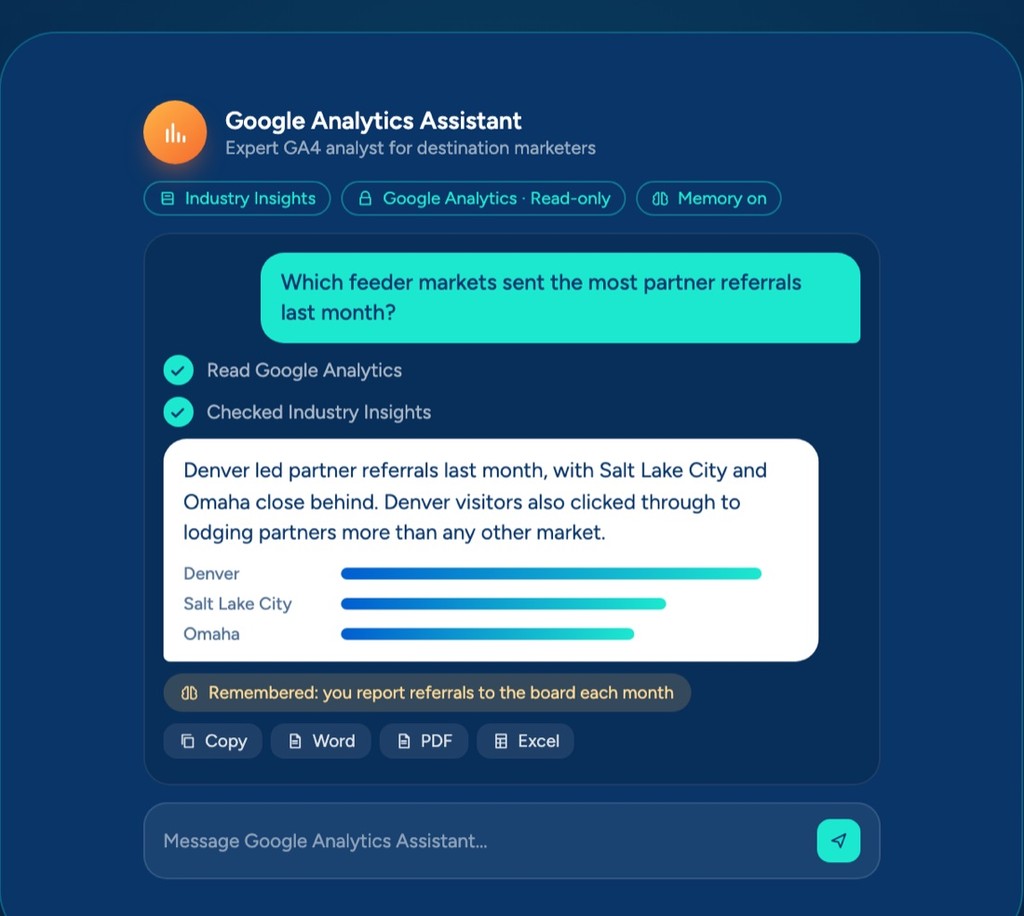 AssistantsAnswers from your Google Analytics, with read-only access.
 ChatOne prompt, a finished board report you can share.
 AI knowledge baseYour files, read by every assistant, agent and flow.
Swix AI
- Reading the inbox
- Drafting RFP replies
- Updating partner listings
- Agents on shift
- Swix
- AI
- Open
Home
BlogJan 29, 2026 · 4 min
The AI Problem Nobody Wants to Talk About
99% of DMO professionals have tried AI, but only half use it regularly. The problem isn't resistance. It's that most tools add work instead of removing it. Here's what to do differently.

Here's a stat that stuck with me: **99% of DMO professionals have now tried AI tools**. But only about half use them on a regular basis.
That gap tells you everything.
AI interest is high. Adoption is low. And it's not because people don't care.
It's because they're exhausted.
The Real Barrier Isn't Resistance
When I talk to destination marketing staff…not leadership…staff, the response to AI is rarely "I don't believe in this" or "this won't work." It's more like a tired sigh.
"Sure, another tool to learn."
"When am I supposed to find time for that?"
"I'm just trying to get through my actual job."
This isn't resistance. It's self-preservation. And honestly? I get it.
Most destination teams aren't short on ideas or ambition. They're overwhelmed by everything that happens between having an idea and actually shipping it.
Starting drafts, rewriting content for the third time, digging through emails for context, explaining the same work to different stakeholders. The grind between "here's what we want to do" and "here's what we delivered" is where the hours evaporate.
When AI gets introduced as one more thing to learn on top of all that, people tune out. Not because they're anti-technology. Because they're trying to survive the week.
Why Most AI Rollouts Stall
Here's something I think more people should say out loud: the fastest way to fail with AI adoption is to ask staff to care about AI.
**A recent survey found** that 56% of employees say AI has actually increased their workload, citing added layers of work and delays from AI usage. More than half. That's the opposite of what was promised.
And it explains why, when leadership announces another AI initiative, a lot of staff quietly check out.
Nobody adopts a tool because it's innovative. They adopt it because it makes their day easier. That's it.
When AI feels abstract ("this will transform how we work!"), it becomes a nice-to-have. Something for later. Something for when things calm down (which is never).
When AI quietly removes friction (fewer blank pages, less rework, context that doesn't disappear), it becomes something people actually reach for. Not because they're excited about AI, but because it helps them get home on time.
The difference between "nice-to-have" and "must-have" isn't features. It's whether the tool makes someone's Wednesday afternoon better.
What We May Be Getting Wrong
I've been in destination marketing for a long time, and I've watched a lot of technology rollouts. The pattern is almost always the same: leadership gets excited, announces a new tool, maybe does a training session (or many), and then... nothing. Adoption flatlines. The tool becomes shelfware.
The mistake, I think, is treating adoption as a mandate rather than a value exchange.
If you want staff to use something, you have to answer one question first: **What's in it for them? Not the organization. Not the five-year strategy. Them, personally, this week.**
When the answer is "less time staring at a blank page" or "fewer rounds of revisions" or "I don't have to explain this project from scratch again", that's when tools stick.
When the answer is "this will help us massively scale our content operations", that's when eyes glaze over.
Questions to Ask Before You Invest in Another AI Tool
If you're evaluating AI tools for your team, here are the questions I'd start with, and none of them are about features:
1. What specific friction does this remove?
Not "what can it do?" but "what annoying thing does it make go away?" If you can't name a specific pain point your team actually complains about, the tool probably won't get used.
2. Can someone get value from it in their first 10 minutes?
Tools that require hours of setup or training before they're useful rarely survive contact with a busy team. The best tools deliver a small win immediately. That's what earns the second session.
3. Does it fit into how the team already works?
Or does it require people to change their habits, learn a new system, or add steps to their process? The more behavior change required, the less likely adoption happens. The best tools feel like a shortcut, not a detour.
4. Will staff tell their coworkers about it?
This is the real test. If someone uses a tool and it genuinely helps them, they mention it to the person in the next desk. If adoption depends entirely on mandates and training sessions, it's probably not solving a problem people actually feel or care about.
The Path Forward
I don't think the answer is necessarily better training or more executive buy-in (though those don't hurt). I think the answer is choosing tools that deliver relief before they deliver transformation.
Staff-first value. Organizational impact follows.
The teams I've seen actually lean in on AI aren't the ones with the most ambitious strategies. They're the ones where someone on staff said, "Oh, this actually helps me." And then told a coworker.
That's how adoption happens. Not by mandate. By word of mouth from people whose lives got a little easier.
What This Means for DMOs
If you're a DMO leader thinking about AI, I'd encourage you to start with one question: What's the most annoying, repetitive part of your team's week?
Not the most strategic opportunity. Not the biggest transformation play. The thing that makes people groan on Monday morning.
Start there. Find a tool that makes that specific thing suck less. Let people experience the relief before you ask them to get excited about the vision.
The AI conversation in our industry has been heavy on potential and light on practical. I think we need to flip that. Solve real problems for real people first.
The transformation takes care of itself.
BlogJan 29, 2026 · 4 min
The AI Problem Nobody Wants to Talk About
99% of DMO professionals have tried AI, but only half use it regularly. The problem isn't resistance. It's that most tools add work instead of removing it. Here's what to do differently.
Here's a stat that stuck with me: **99% of DMO professionals have now tried AI tools**. But only about half use them on a regular basis.
That gap tells you everything.
AI interest is high. Adoption is low. And it's not because people don't care.
It's because they're exhausted.
The Real Barrier Isn't Resistance
When I talk to destination marketing staff…not leadership…staff, the response to AI is rarely "I don't believe in this" or "this won't work." It's more like a tired sigh.
"Sure, another tool to learn."
"When am I supposed to find time for that?"
"I'm just trying to get through my actual job."
This isn't resistance. It's self-preservation. And honestly? I get it.
Most destination teams aren't short on ideas or ambition. They're overwhelmed by everything that happens between having an idea and actually shipping it.
Starting drafts, rewriting content for the third time, digging through emails for context, explaining the same work to different stakeholders. The grind between "here's what we want to do" and "here's what we delivered" is where the hours evaporate.
When AI gets introduced as one more thing to learn on top of all that, people tune out. Not because they're anti-technology. Because they're trying to survive the week.
Why Most AI Rollouts Stall
Here's something I think more people should say out loud: the fastest way to fail with AI adoption is to ask staff to care about AI.
**A recent survey found** that 56% of employees say AI has actually increased their workload, citing added layers of work and delays from AI usage. More than half. That's the opposite of what was promised.
And it explains why, when leadership announces another AI initiative, a lot of staff quietly check out.
Nobody adopts a tool because it's innovative. They adopt it because it makes their day easier. That's it.
When AI feels abstract ("this will transform how we work!"), it becomes a nice-to-have. Something for later. Something for when things calm down (which is never).
When AI quietly removes friction (fewer blank pages, less rework, context that doesn't disappear), it becomes something people actually reach for. Not because they're excited about AI, but because it helps them get home on time.
The difference between "nice-to-have" and "must-have" isn't features. It's whether the tool makes someone's Wednesday afternoon better.
What We May Be Getting Wrong
I've been in destination marketing for a long time, and I've watched a lot of technology rollouts. The pattern is almost always the same: leadership gets excited, announces a new tool, maybe does a training session (or many), and then... nothing. Adoption flatlines. The tool becomes shelfware.
The mistake, I think, is treating adoption as a mandate rather than a value exchange.
If you want staff to use something, you have to answer one question first: **What's in it for them? Not the organization. Not the five-year strategy. Them, personally, this week.**
When the answer is "less time staring at a blank page" or "fewer rounds of revisions" or "I don't have to explain this project from scratch again", that's when tools stick.
When the answer is "this will help us massively scale our content operations", that's when eyes glaze over.
Questions to Ask Before You Invest in Another AI Tool
If you're evaluating AI tools for your team, here are the questions I'd start with, and none of them are about features:
1. What specific friction does this remove?
Not "what can it do?" but "what annoying thing does it make go away?" If you can't name a specific pain point your team actually complains about, the tool probably won't get used.
2. Can someone get value from it in their first 10 minutes?
Tools that require hours of setup or training before they're useful rarely survive contact with a busy team. The best tools deliver a small win immediately. That's what earns the second session.
3. Does it fit into how the team already works?
Or does it require people to change their habits, learn a new system, or add steps to their process? The more behavior change required, the less likely adoption happens. The best tools feel like a shortcut, not a detour.
4. Will staff tell their coworkers about it?
This is the real test. If someone uses a tool and it genuinely helps them, they mention it to the person in the next desk. If adoption depends entirely on mandates and training sessions, it's probably not solving a problem people actually feel or care about.
The Path Forward
I don't think the answer is necessarily better training or more executive buy-in (though those don't hurt). I think the answer is choosing tools that deliver relief before they deliver transformation.
Staff-first value. Organizational impact follows.
The teams I've seen actually lean in on AI aren't the ones with the most ambitious strategies. They're the ones where someone on staff said, "Oh, this actually helps me." And then told a coworker.
That's how adoption happens. Not by mandate. By word of mouth from people whose lives got a little easier.
What This Means for DMOs
If you're a DMO leader thinking about AI, I'd encourage you to start with one question: What's the most annoying, repetitive part of your team's week?
Not the most strategic opportunity. Not the biggest transformation play. The thing that makes people groan on Monday morning.
Start there. Find a tool that makes that specific thing suck less. Let people experience the relief before you ask them to get excited about the vision.
The AI conversation in our industry has been heavy on potential and light on practical. I think we need to flip that. Solve real problems for real people first.
The transformation takes care of itself.
Book a demo
Ready when you are.
Tell us where the hours go. We'll show you Swix working on your destination's real work, and what your first 60 days would look like.
No slides. No obligation.
Book a demo
Ready when you are.
Tell us where the hours go. We'll show you Swix working on your destination's real work, and what your first 60 days would look like.
No slides. No obligation.