
Inside Swix AI
- FeaturesChat, assistants, automations and agents, built for destination teams.
- Agents (AI Workforce)An agent team that plans the work, does it, and checks in when a person has to decide.
- AI AutomationsQuickFlows, ActionFlows and SmartFlows for the work you repeat.
- AssistantsCustom assistants that know your role, your files and your voice.
- ChatAsk in plain words, get back reports, decks and dashboards.
- AI knowledge baseOne library of your files that everything in Swix reads from.
- Security & TrustHow your data is encrypted, isolated and never used to train outside AI models.
 In their words30 min“What used to take me hours now takes me 30 minutes tops.”Jenna McCormick · Destination Creative & Content Manager, Visit Cheyenne
 AgentsPlans the work, does it, and stops for your okay.
 AI AutomationsA monthly board report, drafted in five numbered steps.
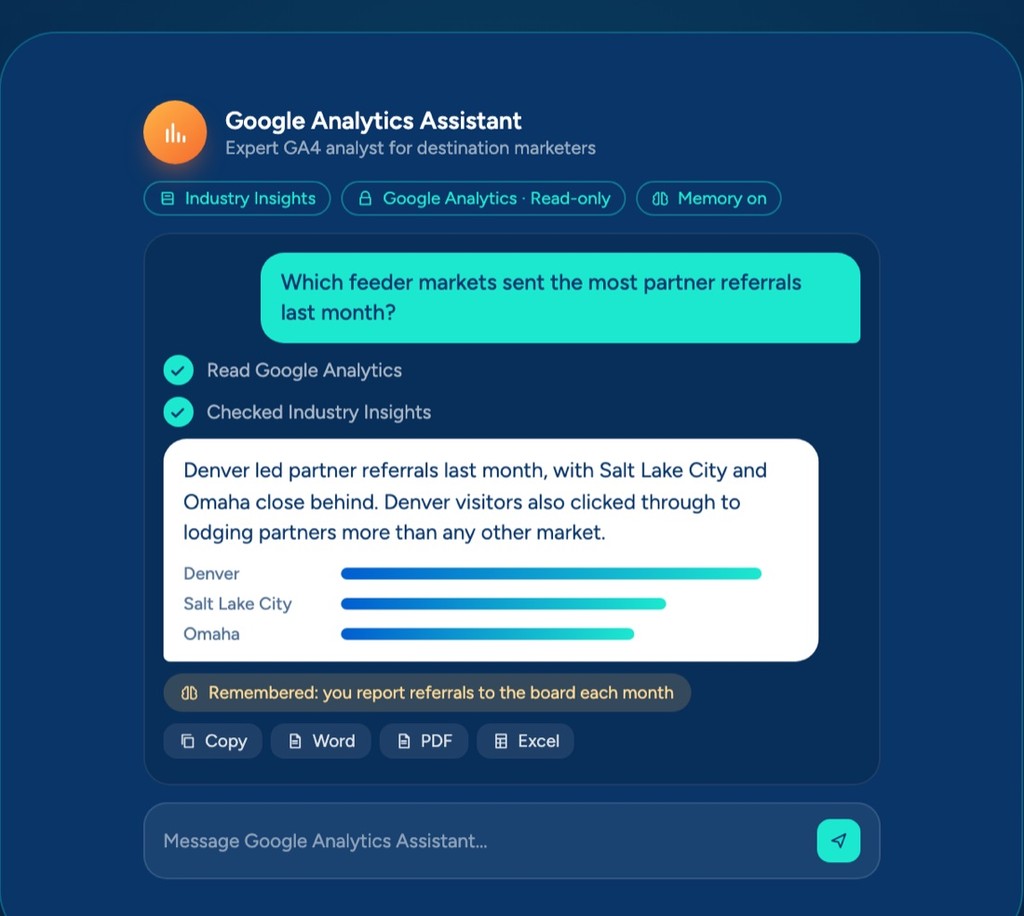 AssistantsAnswers from your Google Analytics, with read-only access.
 ChatOne prompt, a finished board report you can share.
 AI knowledge baseYour files, read by every assistant, agent and flow.
Swix AI
- Reading the inbox
- Drafting RFP replies
- Updating partner listings
- Agents on shift
- Swix
- AI
- Open
Home
GuideJan 12, 2026 · 4 min
Choosing the Right AI Tool: A Simple 4-Level Guide for DMOs
Not every DMO task needs an AI agent. A simple framework, from chat assistants to autonomous agents, helps you pick the right level of AI for each job. Here's how it works.

AI conversations in destination marketing tend to swing between two extremes.
On one side, there’s fear: “This feels risky, complicated, and out of scope for a public-sector organization.”
On the other, there’s hype: “We need AI agents everywhere, immediately.”
The truth, and real opportunity, lives somewhere in between.
The DMOs that will get real value from AI aren’t necessarily the ones chasing the most advanced tools. They’re the ones that understand how much autonomy a specific task actually needs, and choose accordingly.
When AI is explained in technical terms, it can feel abstract and overwhelming.But when you strip it down, most AI use cases inside a DMO fall into just four simple categories.
The difference between success and over-engineering is choosing the right category for the job.
That’s where a simple progression helps.
To make this intuitive, think of AI like transportation. You wouldn’t use the same vehicle for every trip, and you shouldn’t use the same type of AI tool for every task.
Level 1: The Bicycle
AI Chat, Assistants and Custom GPTs (Human-in-the-Loop)
This is the simplest and safest place to start.
A custom GPT or AI assistant works like a bicycle: it only moves when a human pedals. You ask it a question, give it instructions, or ask for a draft, and you stay in control the entire time.
Common DMO examples
- Drafting social posts or blogs
- Creating itineraries or visitor content
- Summarizing email, research, reports, or marketing performance
- Rewriting content in your brand voice
Why this works
- No automation
- No risk of acting on its own
- Perfect for tasks that require judgment, creativity, or approval
The key characteristic is simple: you’re involved every time. You review, refine, and approve the output.
For DMOs, this matters because brand voice, accuracy, and nuance are critical. The Bicycle removes “blank-page” work and reduces time spent on first drafts, while keeping humans firmly in control.
Plain-English takeaway:If you want AI to help you refine, think or write, this is a Bicycle.
Level 2: The Car
Simple Workflow Automation (No AI Thinking or Reasoning)
This level often doesn’t use AI at all, and that’s exactly why it works.Once you’re comfortable with assisted AI, the next step isn’t more intelligence, it’s more reliability. The car is about reliability, not intelligence.
The car represents work that is:
- Completely predictable
- Based on clear rules
- Expected to produce the same outcome every time
This is traditional automation, not “thinking” AI.
This level uses simple automation tools that follow clear rules: If this happens, then do that. There’s no interpretation and no “thinking” involved.
Common DMO examples
- Routing leads to the right team
- Updating CRM records
- Sending confirmation or follow-up emails
- Partner onboarding workflows
Why this works
- The outcome should be the same every time
- AI reasoning would add unnecessary risk
- These tasks quietly save staff hours
Plain-English takeaway:If the steps are predictable and should never change, take a car and put the task on the road.
Level 3: The Train
AI Workflows with Guardrails (Some Thinking Required)
This is where AI begins to “think”, but only within a defined process.
The train follows a set route, but it uses AI at specific points to understand information and make decisions, like sorting, categorizing, or summarizing.
Common DMO examples
- Sorting inbound emails (media, complaints, RFPs)
- Analyzing visitor sentiment across reviews or surveys
- Identifying recurring issues that visitors mention
- Turning unstructured feedback into insights
Why this works
- The process is known, but interpretation is required
- AI helps scale understanding without replacing humans
- Results are easier to trust and explain
The train allows DMOs to “listen at scale” without scaling staff. It turns messy inputs into patterns leadership can actually act on, supporting planning, advocacy, and investment conversations.
Plain-English takeaway:If the steps are fixed but understanding is required along the way, use a train.
Level 4: The Airplane
AI Agents with Autonomy (Advanced Logic Required)
The Airplane is the most advanced tool, and the one that should be used most selectively.
Here, an AI agent is given a goal, not step-by-step instructions. It decides which tools to use and how to reach the outcome, often in real time.
Common DMO examples
- A 24/7 digital concierge
- Personalized itineraries based on weather, time, and interests
- Real-time visitor assistance across multiple systems
Why this works
- The path to the solution is unpredictable
- Autonomy improves the visitor experience
- Requires clear boundaries and oversight
This level only makes sense when the path to the solution is unpredictable and when autonomy clearly improves the visitor experience.
It also requires the most governance.
Airplanes should be deployed selectively, with clear boundaries, monitoring, and ownership. Autonomy without guardrails creates risk, not value.
Plain-English takeaway:If the system needs to figure out how to get the answer on its own, take a flight, you’re in Airplane territory.
The Simple Rule That Ties It All Together
Here’s the principle DMOs can use every time:
Choose the simplest AI tool that reliably solves the problem.
Most DMO tasks don’t need autonomous AI agents.Many don’t even need AI thinking at all.
Starting with a Bicycle and moving up only when necessary:
- Reduces risk
- Builds trust internally
- Prevents over-engineering
Why This Matters for DMOs
DMOs often operate with:
- Public accountability
- Limited staff capacity
- High expectations from partners and communities
This approach respects those realities.
AI doesn’t have to be complicated to be powerful. When explained clearly and applied intentionally, it becomes a practical tool, not a black box.
Sometimes the smartest move isn’t building something more advanced.
It’s choosing the right vehicle for the trip.
GuideJan 12, 2026 · 4 min
Choosing the Right AI Tool: A Simple 4-Level Guide for DMOs
Not every DMO task needs an AI agent. A simple framework, from chat assistants to autonomous agents, helps you pick the right level of AI for each job. Here's how it works.
AI conversations in destination marketing tend to swing between two extremes.
On one side, there’s fear: “This feels risky, complicated, and out of scope for a public-sector organization.”
On the other, there’s hype: “We need AI agents everywhere, immediately.”
The truth, and real opportunity, lives somewhere in between.
The DMOs that will get real value from AI aren’t necessarily the ones chasing the most advanced tools. They’re the ones that understand how much autonomy a specific task actually needs, and choose accordingly.
When AI is explained in technical terms, it can feel abstract and overwhelming.But when you strip it down, most AI use cases inside a DMO fall into just four simple categories.
The difference between success and over-engineering is choosing the right category for the job.
That’s where a simple progression helps.
To make this intuitive, think of AI like transportation. You wouldn’t use the same vehicle for every trip, and you shouldn’t use the same type of AI tool for every task.
Level 1: The Bicycle
AI Chat, Assistants and Custom GPTs (Human-in-the-Loop)
This is the simplest and safest place to start.
A custom GPT or AI assistant works like a bicycle: it only moves when a human pedals. You ask it a question, give it instructions, or ask for a draft, and you stay in control the entire time.
Common DMO examples
- Drafting social posts or blogs
- Creating itineraries or visitor content
- Summarizing email, research, reports, or marketing performance
- Rewriting content in your brand voice
Why this works
- No automation
- No risk of acting on its own
- Perfect for tasks that require judgment, creativity, or approval
The key characteristic is simple: you’re involved every time. You review, refine, and approve the output.
For DMOs, this matters because brand voice, accuracy, and nuance are critical. The Bicycle removes “blank-page” work and reduces time spent on first drafts, while keeping humans firmly in control.
Plain-English takeaway:If you want AI to help you refine, think or write, this is a Bicycle.
Level 2: The Car
Simple Workflow Automation (No AI Thinking or Reasoning)
This level often doesn’t use AI at all, and that’s exactly why it works.Once you’re comfortable with assisted AI, the next step isn’t more intelligence, it’s more reliability. The car is about reliability, not intelligence.
The car represents work that is:
- Completely predictable
- Based on clear rules
- Expected to produce the same outcome every time
This is traditional automation, not “thinking” AI.
This level uses simple automation tools that follow clear rules: If this happens, then do that. There’s no interpretation and no “thinking” involved.
Common DMO examples
- Routing leads to the right team
- Updating CRM records
- Sending confirmation or follow-up emails
- Partner onboarding workflows
Why this works
- The outcome should be the same every time
- AI reasoning would add unnecessary risk
- These tasks quietly save staff hours
Plain-English takeaway:If the steps are predictable and should never change, take a car and put the task on the road.
Level 3: The Train
AI Workflows with Guardrails (Some Thinking Required)
This is where AI begins to “think”, but only within a defined process.
The train follows a set route, but it uses AI at specific points to understand information and make decisions, like sorting, categorizing, or summarizing.
Common DMO examples
- Sorting inbound emails (media, complaints, RFPs)
- Analyzing visitor sentiment across reviews or surveys
- Identifying recurring issues that visitors mention
- Turning unstructured feedback into insights
Why this works
- The process is known, but interpretation is required
- AI helps scale understanding without replacing humans
- Results are easier to trust and explain
The train allows DMOs to “listen at scale” without scaling staff. It turns messy inputs into patterns leadership can actually act on, supporting planning, advocacy, and investment conversations.
Plain-English takeaway:If the steps are fixed but understanding is required along the way, use a train.
Level 4: The Airplane
AI Agents with Autonomy (Advanced Logic Required)
The Airplane is the most advanced tool, and the one that should be used most selectively.
Here, an AI agent is given a goal, not step-by-step instructions. It decides which tools to use and how to reach the outcome, often in real time.
Common DMO examples
- A 24/7 digital concierge
- Personalized itineraries based on weather, time, and interests
- Real-time visitor assistance across multiple systems
Why this works
- The path to the solution is unpredictable
- Autonomy improves the visitor experience
- Requires clear boundaries and oversight
This level only makes sense when the path to the solution is unpredictable and when autonomy clearly improves the visitor experience.
It also requires the most governance.
Airplanes should be deployed selectively, with clear boundaries, monitoring, and ownership. Autonomy without guardrails creates risk, not value.
Plain-English takeaway:If the system needs to figure out how to get the answer on its own, take a flight, you’re in Airplane territory.
The Simple Rule That Ties It All Together
Here’s the principle DMOs can use every time:
Choose the simplest AI tool that reliably solves the problem.
Most DMO tasks don’t need autonomous AI agents.Many don’t even need AI thinking at all.
Starting with a Bicycle and moving up only when necessary:
- Reduces risk
- Builds trust internally
- Prevents over-engineering
Why This Matters for DMOs
DMOs often operate with:
- Public accountability
- Limited staff capacity
- High expectations from partners and communities
This approach respects those realities.
AI doesn’t have to be complicated to be powerful. When explained clearly and applied intentionally, it becomes a practical tool, not a black box.
Sometimes the smartest move isn’t building something more advanced.
It’s choosing the right vehicle for the trip.
Book a demo
Ready when you are.
Tell us where the hours go. We'll show you Swix working on your destination's real work, and what your first 60 days would look like.
No slides. No obligation.
Book a demo
Ready when you are.
Tell us where the hours go. We'll show you Swix working on your destination's real work, and what your first 60 days would look like.
No slides. No obligation.